

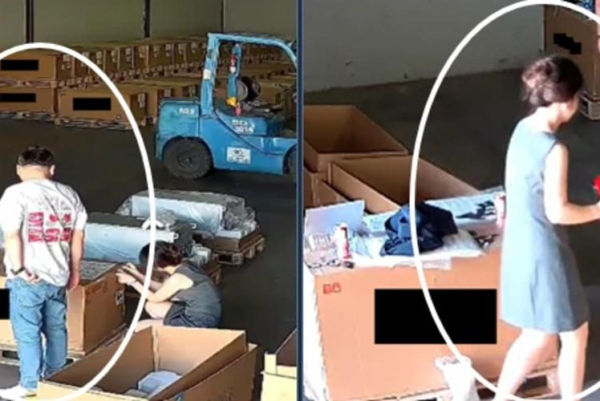
1 of 2 | Ting-Wei “Willy” Sun, left, and a worker from another company, work with “dummy” servers to allegedly conceal Nvidia microchips heading to China. Image courtesy of the Department of Justice
Three men were charged with smuggling Nvidia chips able to run artificial intelligence into China through the company Super Micro Computer in an unsealed indictment.
The indictment, unsealed Thursday said two of the three men worked for server company Supermicro, and one was a contractor.
The unsealed indictment charges Yih-Shyan “Wally” Liaw, 71; Ruei-Tsang “Steven” Chang, 53; and Ting-Wei “Willy” Sun, 44, with conspiring to divert high-performance computer servers assembled in the United States and integrating sophisticated U.S. artificial intelligence technology to China, in violation of U.S. export controls laws.
Liaw is a U.S. citizen from Fremont, Calif., and a co-founder of the company. Chang and Sun are both from Taiwan. Sun was a contractor for Supermicro. Sun and Liaw were arrested on Thursday, and Chang has not yet been found.
The indictment was brought by the U.S. Attorney for the Southern District of New York Jim Clayton, Assistant Director of the Counterintelligence and Espionage Division of the FBI Roman Rozhavsky and Assistant Director in Charge of the New York Field Office of the FBI James C. Barnacle Jr.
“As alleged in the indictment, the defendants participated in a systematic scheme to divert massive quantities of U.S. artificial intelligence technology to customers in China,” said U.S. Attorney Jay Clayton in a statement. “They did so through a tangled web of lies, obfuscation, and concealment — all to drive sales and generate revenues in violation of U.S. law. Diversion schemes like those disrupted today generate billions of dollars in ill-gotten gains and pose a direct threat to U.S. national security.
“Crimes involving sensitive technology must be met with swift action otherwise the law is meaningless,” Clayton added. “We will continue to doggedly investigate and prosecute these illegal diversion schemes.”
“The server company’s products containing Nvidia chips are subject to strict U.S. export controls barring their sale to China without a license,” the indictment said. “Those controls are in place to protect U.S. national security and foreign policy interests, among other things.”
Shares of Supermicro fell 25% after the indictment was announced, CNBC reported.
Supermicro placed the two employees on administrative leave and terminated its relationship with the contractor, effective immediately, a company press release said.
“The conduct by these individuals alleged in the indictment is a contravention of the company’s policies and compliance controls, including efforts to circumvent applicable export control laws and regulations,” the release said. “Supermicro maintains a robust compliance program and is committed to full adherence to all applicable U.S. export and re-export control laws and regulations.”
It noted that the company is fully cooperating with the U.S. government and is not named as a defendant.
Another Southeast Asian company created fake paperwork to appear as if it would be using the servers and had a separate logistics firm repackage the servers to conceal them before going to China, the indictment said.
They tried to fool the server maker’s compliance team with “dummy” servers at the second company’s storage facilities, while the real servers had already been sent to China. They also pressured the compliance team to approve shipments, the indictment said. They allegedly also used “dummy” servers during a visit from a U.S. export control officer.
The scheme has brought in around $2.5 billion in sales for the company since 2024, with servers sold for $510 million between late April 2025 and mid-May 2025 going to the second company and on to China, the indictment said. The plaintiff said the server maker had no U.S. Commerce Department license to export servers featuring Nvidia GPUs to China.
This week in Washington
President Donald Trump makes remarks as he stands with Prime Minster Takeuchi Sanae of Japan during a dinner event in the State Dining Room of the White House on Thursday. Photo by Aaron Schwartz/UPI | License Photo
