
U.S. Forces Korea declines to discuss movements, citing operational security


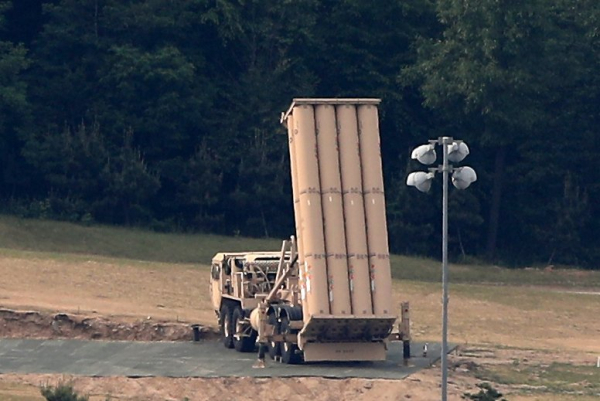
A Terminal High Altitude Area Defense (THAAD) launcher is seen at a golf course in Seongju, about 300 kilometers southeast of Seoul, Korea. Photo by Yonhap News Agency / UPI
All six U.S. Terminal High Altitude Area Defense launcher vehicles that had been moved from a base in southeastern South Korea during the U.S.-Iran war have reportedly returned to the installation.
The launchers were seen back at the U.S. military base in Seongju County, North Gyeongsang Province, Yonhap News Agency reported Sunday.
A THAAD battery generally consists of a fire-control and communications unit, radar equipment and six truck-mounted launchers.
The six launchers were reportedly moved in March from Seongju to Osan Air Base in Pyeongtaek, about 40 miles south of Seoul.
Osan frequently handles large U.S. military transport aircraft, including C-5 Galaxy and C-17 Globemaster planes.
The movement prompted speculation that THAAD interceptor missiles assigned to the South Korean battery could be sent to the Middle East to support U.S. military operations against Iran.
Military officials and analysts, however, said the launcher vehicles and other major elements of the THAAD system were unlikely to have left South Korea.
Gen. Xavier Brunson, commander of U.S. Forces Korea, told the Senate Armed Services Committee on April 21 that the United States had not moved a THAAD system from the Korean Peninsula.
“We have not moved any THAAD system,” Brunson said. “THAAD remains on the Korean Peninsula.”
Brunson said the United States was sending munitions and that they were awaiting movement, distinguishing the interceptors from the broader missile defense system.
South Korean Defense Minister Ahn Gyu-back also said during a May 12 meeting with correspondents at the South Korean Embassy in Washington that Seoul and Washington had not discussed transferring the THAAD system deployed in South Korea to the Middle East.
U.S. Forces Korea declined to confirm the return of the launcher vehicles.
“For operational security reasons, we cannot comment on specific troop movements, capabilities or operational matters,” the command said.
It referred questions about U.S. force deployment and readiness to Brunson’s congressional testimony.
The THAAD battery was deployed in Seongju to defend South Korea and U.S. forces against North Korean ballistic missile threats.
The system is designed to intercept short-, medium- and intermediate-range ballistic missiles during the terminal phase of flight.
— Reported by Asia Today; translated by UPI
© Asia Today. Unauthorized reproduction or redistribution prohibited.
Original Korean report: https://www.asiatoday.co.kr/kn/view.php?key=20260621010007234
