

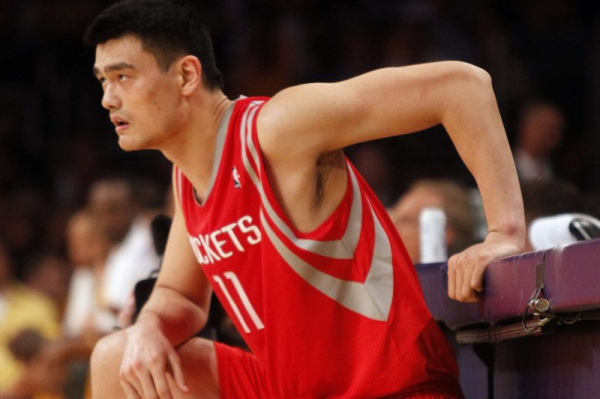
Yao Ming’s career with the Houston Rockets transformed basketball into a shared cultural space linking American and Chinese audiences through “hoop diplomacy.” File Photo by Lori Shepler/UPI | License Photo
As millions of Americans fill out brackets for March Madness, the annual NCAA basketball tournament offers more than collegiate drama — it highlights the quiet power of sport to build bridges across cultures and borders.
From the Cold War’s ping-pong exchanges that helped thaw relations between the United States and China to the rare sight of athletes marching under a unified Korean flag at the Olympics, sports has repeatedly opened diplomatic channels when politics stalled.
As geopolitical fragmentation deepens and Washington launches its U.S. Decade of Sports, policymakers may find that sports diplomacy offers an overlooked tool for engagement across Asia.
The Indo-Pacific offers fertile ground for this approach. Basketball courts and soccer fields have become unlikely arenas of diplomacy, particularly in Southeast Asia where sports culture runs deep among youthful populations.
Vietnam provides a compelling example. Once defined by wartime rivalry with the United States, the country now hosts a fast-growing professional basketball league and a vibrant sports exchange ecosystem supported by U.S. diplomatic outreach.
American coaches, athletes and cultural programs regularly engage Vietnamese youth through clinics, tournaments and community events — efforts that foster personal connections far removed from formal statecraft.
For Washington, such exchanges reinforce broader diplomatic engagement in a region where strategic competition is intensifying but where relationship-building remains central to trust.
“The globalization of sports such as football and basketball has created new arenas for cultural engagement,” said Professor Robert Kelley from the School of International Service at American University.
But Kelley cautioned that once the term “diplomacy” is attached — whether to science or sports — the activity inevitably takes on political significance.
Southeast Asia already has the institutional foundations for sports-based engagement. The biennial Southeast Asian Games, first held in 1959, has for decades brought together athletes from across the region, reinforcing a sense of regional identity through competition.
Its development alongside the Association of Southeast Asian Nations, founded in 1967, illustrates how sports and diplomacy have long evolved in parallel. As political tensions and martime disputes in the South China Sea test regional cohesion, athletic exchanges have continued to provide a platform for cooperation.
Even the contested waters of the South China Sea are doubling as unlikely venues for regional sports diplomacy. High-profile sailing events such as the Volvo China Coast Regatta, organized by the Royal Hong Kong Yacht Club, draw top Asian sailors for multi-day offshore racing off Hong Kong and along China’s southern coast.
“The conflicts facing the world today demand immediate solutions, which can make a youth sports exchanges a challenging sell among stakeholders,” said Professor Thu Hoang of Hanoi University, noting that the benefits often take years to materialize.
“But that is precisely why sports programs matter, ” he added. “When today’s young athletes grow into leaders, they will carry these positive experiences with them — shaping how they view cooperation and international relationships.”
Analysts say the United States could build on this existing regional framework by integrating sports diplomacy into its Indo-Pacific strategy. Programs that connect U.S. military personnel, diplomats, and local communities through sporting events or youth exchanges could complement traditional defense partnerships.
In a region where long-term relationship building often carries as much weight as formal agreements, sports can serve as an effective tool for strengthening trust and unlocking more strategic engagement.
“I liken sports diplomacy to a Swiss Army knife for international and sports relations. It’s an asset that can strengthen diplomatic and sporting toolkits, whether it’s driving trade, tourism, and investment, or whether it’s helping to build reputations or to negotiate foreign perspectives,” said Lindsay Sarah Krasnoff, a sports diplomacy expert and clinical assistant professor at NYU Tisch Institute for Global Sport.
Among Southeast Asian partners, Vietnam offers a promising opportunity for expanded sports diplomacy. As U.S.-Vietnam relations deepened under their Comprehensive Strategic Partnership, athletic exchanges could complement growing cooperation in trade, education and security.
Vietnam’s rapidly expanding interest in international sports — from basketball and football to regional competitions — provides a natural platform for people-to-people engagement.
Ted Osius, former U.S. ambassador to Vietnam, said sports — especially basketball — have played a quiet, but powerful, role in strengthening ties between the two countries.
He recalled an example involving Aki Minh Pham, who as a high school student organized a group of basketball players from suburban Maryland to travel to Hanoi. While Pham spoke Vietnamese, most of his teammates did not, but language proved no barrier once the games began. On the court, shared competition and teamwork bridged the cultural divide.
This type of cultural or sports diplomacy not only contribute to reconciliation between two former enemies, but also helps position Hanoi as a partner in Washington’s continued freedom of navigation operations and expanded military partnerships since most Southeast Asian nations find themselves navigating between competing powers.
The intensifying Sino-U.S. rivalry in the region continues to cast a long shadow over regional cooperation and partnerships. Even initiatives designed to advance stability or environmental governance risk invoking China’s ire.
Within the Quadrilateral Security Dialogue — the Quad partnership linking the United States, Australia, Japan and India — sports initiatives could easily be expanded. Joint sports exchanges, youth leagues and coaching clinics would complement the Quad’s existing work in maritime security, infrastructure and technology, while signaling that the partnership also invests in the region’s communities and future generations.
This is precisely where sports diplomacy can offer a quieter channel of engagement. Athletic exchanges operate outside the traditional security framework, allowing cooperation without forcing governments to align on sensitive geopolitical issues.
The history of U.S.-China engagement offers a powerful example. While “ping-pong diplomacy” helped reopen dialogue in the 1970s, later decades saw sports continue to bridge divides, including the global rise of Yao Ming, whose career with the Houston Rockets transformed basketball into a shared cultural space linking American and Chinese audiences through “hoop diplomacy.”
Washington’s increasingly transactional approaches leaves regional governments balancing U.S. proposals against potential political and economic repercussions from Beijing-a dynamic that often discourages closer alignment with the U. S. This imbalance underscores the promise of sports and cultural diplomacy.
Incorporating sports into existing security frameworks may offer a practical pathway to deepen diplomatic ties and reinforce military cooperation — without provoking sharp retaliation from China. U.S. Rep Sydney Kamlager-Dove, D-Calif., provides a clear case in point.
During a visit to Japan, she tapped the power of sports diplomacy by presenting a Los Angeles Dodgers jersey honoring Shohei Ohtani, Japan’s international baseball star. Kamlager-Dove recalled that Japanese Defense Minister Minoru Kihara put it on immediately and posed for photos — a simple gesture that soon opened the door to additional meetings with Japanese officials.
Meaningful implementation of sports can build upon existing practices. During an year-end four-day port visit to Da Nang, U.S. naval officers met with Vietnamese civilian and military leaders and took part in professional exchanges and sporting events with their counterparts, underscoring how routine naval visits can foster broader engagement combined with sports activities.
“Programs that focus on coaching development, youth leadership through sports and international competitions have often helped create sustained channels of engagement between societies that might otherwise have limited interaction,” said Terry K. Harvey, vice president of culture and sports diplomacy at Meridian International Center.
The opportunity exists in Vietnam, where sports already serve as a vibrant part of national culture and a natural platform for engagement.
In 2017, a group of student-athletes from the University of Tennessee traveled to Vietnam through the VOLeaders Academy, using sport as a bridge across cultures. After touring Vietnam’s National Training Center, student-athlete, Joey Reilman underscored the importance of mindset over resources.
“Our facilities should not define our success; it should be based on character and teamwork. You can have success with very little,” he said.
For Washington, the lesson is straightforward. Strategic competition in the Indo-Pacific will unfold not only in boardrooms and naval exercises but also on playing fields, courts and sailing waters.
In an era of rising geopolitical tension, sometimes the most effective diplomacy begins not with a formal negotiation, but with the simple act of playing the game together.
