


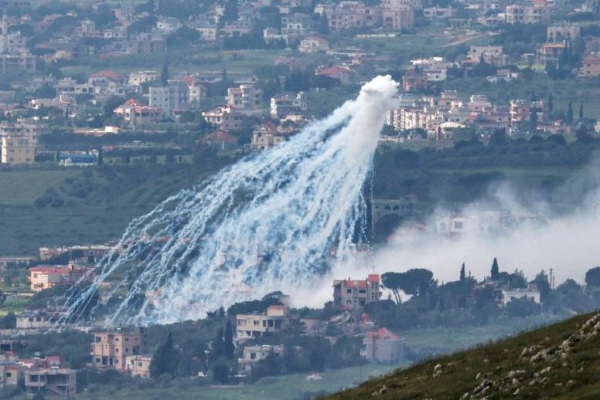
Smoke rises following Israeli arterially shelling in a southern Lebanese village, as seen from the Upper Galilee in northern Israel on Tuesday, amid a cease-fire between Israel and Lebanon. Photo by Atef Safadi/EPA
Lebanon and Israel have embarked on direct negotiations to potentially end their decades-long military conflict, but their differing priorities, objectives and expectations raise concerns about the process’s viability and its reliance on U.S. President Donald Trump’s personal involvement.
Trump, who surprised everyone by attending the second meeting between the Lebanese and Israeli ambassadors last week in Washington, also has his own interests, calculations and a hasty negotiation style.
He pressured Israeli Prime Minister Benjamin Netanyahu to accept Lebanon’s request for extending the April 17 cease-fire and embarrassed Lebanese President Joseph Aoun by inviting him to meet Netanyahu at the White House.
In an unexpected policy shift last month, Aoun announced he was ready for direct negotiations with Israel — a proposal initially ignored by Netanyahu — to secure a full truce and end Israeli attacks on Lebanon.
However, his plans do not include any phone calls with Israeli Prime Minister Benjamin Netanyahu or in-person meetings with him.
Aoun is keen not to fall into a trap and be cornered into making free concessions to Israel. He is already facing harsh opposition from Hezbollah, which accuses him of betrayal and treason over the direct negotiations and the decision to disarm it.
However, he has remained determined to proceed with the diplomatic path he chose to end the war with Israel, hitting back at Hezbollah for committing “betrayal” by dragging the country into war “to serve external interests.”
Hezbollah, which opened a support front for Gaza on October 8, 2023 — halted by a ceasefire more than a year later — resumed fighting on March 2.
The group said this came in response to the killing of Iran’s Supreme Leader Ayatollah Ali Khamenei on the first day of the U.S.-Israel war on Iran, and to Israel’s continued strikes on Lebanon, which have never stopped since the Nov. 27, 2024, truce.
The escalation, which has exacerbated Lebanon’s already catastrophic conditions, has killed 2,521 people, injured 7,804 and displaced 1.2 million. It has also intensified Israeli attacks, resulting in the occupation of more territory, establishment of a 6.2-mile military zone and destruction of dozens of border villages.
Aoun’s five-point negotiation demands were, in fact, aligned with what Hezbollah seeks — but not through direct talks: consolidating the cease-fire, securing Israel’s withdrawal from occupied Lebanese territories, obtaining the release of Lebanese prisoners captured during the war, enabling the return of displaced people to their homes and villages, and initiating reconstruction
But the negotiating process — if successful — would initially lead to either a security arrangement or a return to the 1949 armistice, as Lebanon aspires to, or to a full-fledged peace accord, as sought by Israel.
Talking peace with Israel “is still very premature” and will take place on Lebanon’s timing and under “the right circumstances,” a Lebanese official source said.
“There are a lot of ifs before reaching that point,” the source told UPI, referring to the Israeli withdrawal, deployment of the Lebanese Army to the border and return of the Lebanese displaced, among Lebanon’s demands.
For that, Lebanon is counting specifically on Trump as a guarantor of any agreement with Israel, as “he is the one who can pressure Netanyahu” into pulling his forces out of south Lebanon, according to the source.
This would be a risky bargain, though, as there are limits to how far Trump can go in pressuring the Israeli prime minister.
Hilal Khashan, a professor of political science at the American University of Beirut, said the idea behind the Israeli-Lebanese peace talks is to manage the conflict rather than resolve it.
Israel is creating a security belt inside southern Lebanon, demolishing housing in at least 55 border villages to defend what it calls its “forward defense lines” — the territories it has seized – thereby making its withdrawal unlikely, Khashan said.
“They want to reach the Litani River. … This has been their dream even before the creation of the State of Israel [in 1948],” he told UPI. “This is a fundamental issue for the Israelis. …. Hezbollah is an excuse.”
Khashan said Israel also wants the Lebanese Army to act against Hezbollah by disarming it, even if that causes “the implosion of Lebanon and its territorial fragmentation” — an outcome that would serve Israeli “objectives.”
He maintained that even if Hezbollah is disarmed, Israel will continue to insist on a demilitarized zone and will not withdraw from the newly established security belt in southern Lebanon.
Hezbollah’s arsenal is also a significant concern for Lebanon, as it seeks to restore its long-lost sovereignty and enforce the state’s monopoly on arms.
Antoine Chedid, Lebanon’s former ambassador to the United States, said the Lebanese state will do what is required to ensure the “exclusive control of weapons” in the country, as clearly stated in the 2024 truce agreement, but is proceeding “carefully,” knowing “how difficult it is” to avoid internal strife.
“The magic word in those [Israeli-Lebanese] negotiations is solely the disarming of Hezbollah,” Chedid told UPI.
He said direct negotiations represent “an opportunity that Lebanon should not miss,” although they have come a bit late and have created some divisions within the country, with Hezbollah and its Shiite Amal movement ally objecting to them.
Chedid also said the issue of holding direct talks emerged because “the conditions have changed, and the region has changed,” allowing Lebanon “to put on the table its demands and conditions in a clear way.”
“It is the correct approach to retrieve our lands and to try to get what we want with the U.S. as a broker,” Chedid said, referring to the Israeli withdrawal from “every inch” of Lebanese occupied territories, a return to the 1949 armistice agreement and the resolution of 13 disputed border points, “which is something not difficult to achieve.”
Lebanon’s decision to pursue independent negotiations with Israel and distance itself from Iran was a move blessed by the United States and supported by many Lebanese.
However, the U.S.-Iran negotiations track in Islamabad could affect — and possibly benefit –Lebanon once it addresses the issue of Tehran’s armed proxies in the region, particularly Hezbollah.
According to Khashan, Iran will sooner or later accept U.S. terms that include separating the Hezbollah track, “formally abandoning” the Lebanese militant group, and stopping the supply of military hardware.
“They would continue to support Hezbollah financially, but Iran is not in a position to support anyone financially, not even itself,” he said.
Once — and if it is — resolved between Washington and Tehran, the problem of Hezbollah will be easier to resolve, though this remains to be seen given the complexity of the U.S.-Iran negotiations.
Lebanon will not move quickly toward a peace agreement with Israel, on the advice of Saudi Arabia and France in particular.
“Our ceiling is the 2002 Arab Peace Initiative,’ the Lebanese official source said, referring to the historic proposal during an Arab summit in Beirut by the late Saudi Crown Prince Abdullah for Arab states to recognize Israel and normalize relations with it in exchange for an independent Palestinian state.
“We will be behind the Arab countries on this matter and will not conclude peace with Israel before them,” the source said. “If this happens, we will be part of it.”
Normalizing ties with Israel — after decades of a bloody struggle — will also not be quick or easy, with many Lebanese opposing it.
