

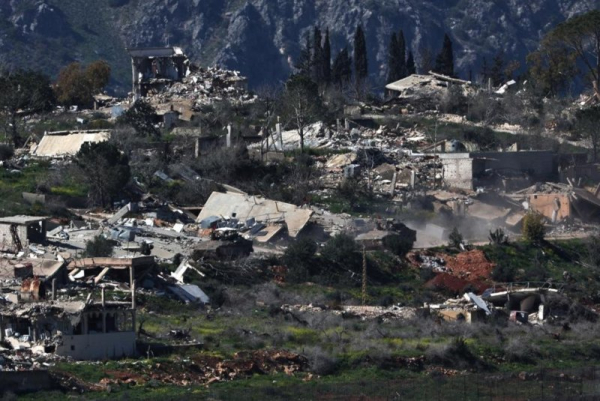
Israeli military vehicles maneuver in the southern Lebanese village of Kfar Kila, as seen from the border in Upper Galilee, northern Israel, on Thursday. The Israeli military is conducting strikes across Lebanon targeting Hezbollah infrastructure and personnel. Photo by Atef Safadi/EPA
Hezbollah, significantly degraded but still armed, has again ventured to drag Lebanon into another war — this time in support of Iran — by resuming military actions against Israel and risking a longer occupation, greater destruction and further destabilization of Lebanon, analysts said.
The assassination of Iran’s Supreme Leader, Ayatollah Ali Khamenei, on the first day of the war Saturday triggered Hezbollah to launch missiles and drones at northern Israel early Monday after months of relative restraint.
Whether the Shiite militant group, which has been funded and heavily armed by Iran since its establishment in the early 1980s, took the decision itself or acted on orders from its patron, the outcome would not change.
Hezbollah Secretary Sheikh Naim Qassem said Wednesday night that his group resumed military activities in response to 15 months of Israeli aggressions since the Nov. 27, 2024, cease‑fire — achieved to end the 2023 Hezbollah‑Israel war — and Khamanei’s killing
From the Israeli perspective, Hezbollah has fallen into a “strategic trap,” a statement interpreted as giving it the opportunity to destroy the group, meaning Israel now believes it has political and military freedom to inflict major damage on the group.
Hilal Khashan, a professor of political science at the American University of Beirut, said the Iranians had ordered Hezbollah to take part in the fighting and that, based on their Shiite faith, they “accept the commandments of their superiors unquestionably.”
“It is suicidal, but their logic is different,” Khashan told UPI. “There is a dictate and they have to abide by it.”
He observed that Hezbollah refrained from retaliating for the 2024 assassination of its long-time charismatic leader, Hassan Nasrallah, and for post-truce Israeli attacks on its positions and operatives.
The Lebanese government, which began to disarm Hezbollah, but has struggled to accelerate the process, sought to distance itself further from the group after it refused to lay down its arms. The government then declared Hezbollah’s military and security activities unlawful.
“The government is essentially saying that it is at odds with Hezbollah and not responsible for its actions,” Khashan said. “That’s the best it can do — perhaps waiting for Israel to finish off Hezbollah.”
Analysts contend that Hezbollah’s first strategic mistake was opening a front in support of Hamas on Oct. 8, 2023, expecting a two- to three-week campaign. The conflict, which saw Israel operate with near total freedom, greatly weakened Hezbollah, killed senior officials and civilians, and caused widespread destruction across southern Lebanon and other areas.
No one expected Hezbollah now to engage in the conflict to support Iran because of destructive consequences, at least not in its first days, according to Hisham Jaber, a Lebanese military expert and former Army general.
“We entered a war without horizon, limits or breaks,” Jaber told UPI, describing the situation as “very dangerous.”
He said Hezbollah’s missile and drone attacks carried out so far are unlikely to deter Israel unless they force residents in northern Israel to flee — while hundreds of thousands of Lebanese have already been displaced by Israeli strikes in southern Lebanon and in the southern suburbs of Beirut.
Jaber said, however, that the group is believed still to possess strategic weapons — according to Israeli estimates — including thousands of ballistic and precision missiles, reportedly hidden deep in the mountains in Lebanon.
The question remains whether Hezbollah, which has tried to reorganize its ranks and rebuild its capabilities, can continue firing missiles and sustain a long conflict. What is certain is that Lebanon cannot bear another war.
Fadi Daoud, a retired Lebanese Army brigadier general, said he doubted that Hezbollah could continue the war after Israel destroyed much of its arsenal during the support campaign for Gaza.
Daoud warned, however, that Israel has a “vital goal,” which is to “uproot” Hezbollah from its northern borders, not leaving “even a small cell of the group … to grow and expand.”
“What we are seeing now is the beginning,” he told UPI.
He said Israel might be planning a ground incursion in southern and eastern Lebanon instead of relying solely on airstrikes, reportedly aiming to create a buffer zone in southern Lebanon and destroy Hezbollah’s infrastructure.
He warned of the danger of “emptying” southern Lebanon of its residents after Israel ordered them to leave, and of the possible destruction of every village, as happened in Gaza.
“That means long occupation that will have repercussions on the other regions in Lebanon,” he added.
Immediate diplomatic action emerged as Lebanon’s only option to pressure Israel to reconsider its plans to destroy the southern suburbs of Beirut and launch a ground incursion.
“The Lebanese government should act quickly, asking the United States to help secure a cease-fire. … Otherwise, Lebanon faces destruction,” Jaber said.
He said a cease-fire must be imposed on Hezbollah so that it cannot fire “a single bullet,” adding that waiting for the war with Iran to end is a luxury Lebanon cannot afford.
That would require exceptional, and inherently risky, decisions by the Lebanese government amid widespread fears of confrontation with Hezbollah, disintegration of the Lebanese Army and civil unrest.
