


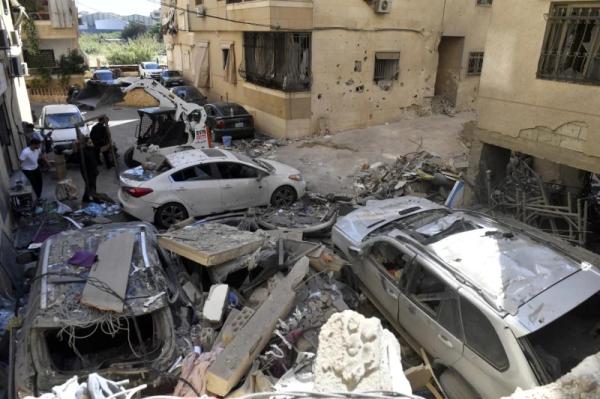
Damaged vehicles are seen following an Israeli airstrike that targeted an apartment in Choueifat, south of Beirut, Lebanon, on May 28, 2026. The Lebanese Ministry of Health said that, as of that date, Israeli attacks across Lebanon had killed more than 3,275 people and injured more than 9,850 since renewed hostilities between Israel and Hezbollah began. Photo by Wael Hamzeh/EPA
Lebanon’s Muslim Shiite community, whose fortunes rose with the once-powerful Hezbollah, is facing what many are likening it to a “semi-Nakba.”
Shiites are bearing much of the cost of Israel’s campaign against the Iran-backed group through the systematic displacement, destruction and depopulation of southern Lebanon — their historic heartland.
Fear, anger, and anxiety are mounting: this time not only over the community’s future, but over its existence.
The devastation wrought by Israel’s attacks since October 2023 — killing thousands and wiping out entire villages, with a weakened Hezbollah unable to retaliate forcefully — has never been seen before.
The latest escalation, which began on March 2, has killed 3,412 people and wounded 10,269, according to an updated count released by the Lebanese Health Ministry on Sunday.
Signs of dissatisfaction with, and once-largely muted criticism of Hezbollah began to emerge both discreetly and openly.
With Israel intensifying its airstrikes and advancing deeper into southern Lebanon beyond its recently self-proclaimed “Yellow Zone,” rendering parts of the region unlivable, fears of a prolonged occupation and long-term displacement grew.
Divisions over Hezbollah’s responsibility for drawing Lebanon into a devastating conflict, and over its refusal to relinquish its weapons, have intensified amid an ongoing debate over who can best protect Lebanon from Israeli aggression.
Hezbollah’s sacrifices and resistance, which succeeded in pushing Israel to withdraw and in liberating southern Lebanon in 2000, were praised at the time. But its involvement in three subsequent wars with Israel, including the last two in support of Gaza and Iran, has shifted perceptions and gradually turned the tables on the militant group.
Shiite mood is changing, according to a resident of the Baalbeck-Hermel district in eastern Lebanon’s Bekaa Valley — another of Hezbollah’s support base.
He explained that although the Bekaa has not suffered as much destruction as the southern region, there have been a large number of casualties, “more than expected,” including 180 Hezbollah fighters killed in the war since March 2 — 100 of whom were buried discreetly, while the others remain unaccounted for.
The fighters’ families were among those still supporting Hezbollah and its ideological and religious allegiance to Iran’s Supreme Leader under the doctrine of Wilayat al-Faqih, despite the fact that Iranian funding has recently decreased.
“Those who used to get $1,000 per month are now receiving $600 to $700,” the resident, who asked not to be identified, told UPI.
Others who used to benefit from Hezbollah’s social, medical and housing financial support, were not as lucky — with many receiving nothing but remaining silent, without yet opposing Hezbollah.
He said they were in a “wait-and-see” situation, fearing they might lose access to financial support if the group secures funding for post-war reconstruction.
Saoud el-Mawla, an academic and researcher specializing in political and religious sociology, argued that Shiites’ support for Hezbollah was political rather than religious, and not rooted in the doctrine of Wilayat al-Faqih.
“The religious factor gave it strength,” el-Mawla said in an interview with UPI, explaining that the group’s rise since 2005 enabled it to expand within state institutions, including security bodies, before it suffered a setback when it opened a support front for Gaza on October 8, 2023, which escalated into a destructive war.
Worse, neither Iran nor its regional proxies — the Houthis in Yemen and armed groups in Iraq — came to its aid as Israel assassinated top commanders, degraded its military capabilities, and struck mostly Shiite populations in southern Lebanon and elsewhere.
“This has created a sense of betrayal, weakness, and abandonment,” el-Mawla said.
Iran’s pledges to impose an end to the Lebanon-Israel war as part of its negotiations with the United States have so far failed to materialize, deepening doubts even among some Hezbollah supporters.
However, to justify retaining its weapons and sustain Shiite support, Hezbollah has warned against threats from the new Sunni-led regime in neighboring Syria, as well as reports of possible displacement to Iraq and other countries, according to el-Mawla and the resident of the Bekaa region.
“For Hezbollah, the war is not merely an operation to end its anti-Israel resistance, but one concerning the very existence of the Shiite community,” el-Malwa explained.
Most of the 1.2 million people displaced by the war fear they may never return due to Israel’s large-scale destruction of their homes, villages, neighborhoods, and vital infrastructure in southern Lebanon.
Such displacement has left many Shiites uprooted from their land and living through “a Nakba even worse than the Palestinian one,” said Mona Fayad, an anti-Hezbollah political activist, writer and psychology professor.
Even if the war stops today and funds are made available, Fayad argued that reconstruction will take at least 10 years, leaving the displaced away from their homes and land in prolonged displacement.
“It is a very dangerous situation,” she told UPI, questioning whether the Lebanese state, given its limited resources, and host communities can continue to sustain the displaced over the long term,
She pointed to signs of Hezbollah supporters — exhausted by repeated wars — distancing themselves from the group as a form of “quiet resistance,” including their failure to respond to calls for protests in support of the militant group.
Despite being weakened militarily and financially and its support base reportedly diminishing, it would be wrong to conclude that Hezbollah is finished, the resident of the Bekaa region cautioned.
“The group still retains manpower and funding and remains capable of continued confrontation, but it is impossible for it to continue in this way; it will simply take time,” he noted.
Shiites, who have relied on Iran since Hezbollah’s creation four decades ago, would need to be more fully integrated into the Lebanese state and broader society.
“Their only guarantee rests in Lebanon’s internal unity and coexistence,” said former parliamentarian and politician Fares Souaid, who described Lebanese Shiites as “a battered community.”
Souaid told UPI that Lebanon is in a multidimensional crisis, “with no solution for Shiites, Sunnis, and Christians except a national solution for all communities and a return to the Constitution.”
