

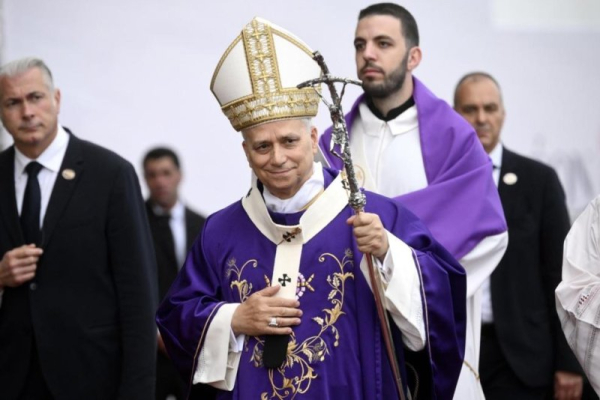
Pope Leo XIV is shown during a holy mass at the “Beirut Waterfront” in Beirut, Lebanon, on Tuesday. Leo ended his first apostolic visit outside Italy since his election as pontiff. He first visited visited Turkey and then Lebanon. Photo by Alessandro Di Meo/EPA
Pope Leo XIV’s call for the conflict-ridden Middle East to change course and choose peace over the “horror of war” comes at a time when regional fears of state fragmentation, renewed displacement and a threatened future — especially for its Christian communities — are growing.
Leo, who concluded a three-day visit to Lebanon on Tuesday as part of his first official trip abroad, presented his vision for the Middle East, urging its leaders and people to embrace coexistence, fraternity, dialogue, reconciliation and peace.
He hopes to involve the entire Middle East “in this spirit of fraternity and commitment to peace,” including “those who currently consider themselves enemies.”
While he refrained from explicitly mentioning Israel during his numerous speeches, he called for an end of hostilities and for recognizing that “armed struggle brings no benefit” while “negotiation, mediation and dialogue are constructive.”
Speaking to journalists aboard the papal plane returning to Rome, the leader of the Catholic Church said he believes that “sustainable peace is achievable” and could once again return to the region.
However, that requires a Middle East changing course “to reset the mindset of revenge and violence,” and to overcome divisions.
The pope’s call for peace, even without naming Israel, is “a deliberate diplomatic move” that allows him to condemn escalation and war from all sides while preserving his role as a moral reference and potential mediator, according to Imad Salamey, a senior Middle East policy adviser and professor of political science and international affairs.
His particular attention to and support for war-torn, crisis-ridden Lebanon — home to the region’s largest Christian population — stems from the fact that the tiny Arab country still represents “a message of freedom, an example of pluralism and coexistence,” as described by the late John Paul II.
By meeting the country’s top political and religious leaders, holding an interfaith gathering, sharing the grief of those who lost loved ones in the 2020 Beirut port explosion and encouraging young people to dream and resist despair, Leo brought a fresh boost of hope; a brief respite amid the ongoing war with Israel.
“His visit comes at a time the situation is so dangerous,” David Wood, a senior Lebanon analyst at the International Crisis Group, told UPI. “It is a strong message that the Vatican did not forget Lebanon and will not abandon it at this particular time. … It resonates not with the Christians only, but also non-Christians in Lebanon.”
While Lebanon’s problems extend beyond Hezbollah’s disarmament and Israel’s violations of the 2024 cease-fire agreement, the pope urged Lebanon’s leaders to take “serious actions” to address the internal causes of the country’s crises, including ensuring accountability for the port explosion, according to Wood.
“The pope is encouraging them to act truly in the national interest and put aside individual differences,” he said.
Leo was clearly addressing Lebanon’s need to avoid internal collapse, but his appeal to religious and political leaders to unite cannot, by itself, override Lebanon’s entrenched sectarian system, foreign interference, security fears and social fragmentation, Salamey said.
“Yet, it still matters. It offers moral cover to any leader willing to compromise [and] slightly softens sectarian boundaries by putting all authorities on the same moral stage,” he told UPI.
However, he warned that repeated Israeli wars, forced displacement and attempts to “reshape” the Middle East map by force are pushing Christians and other communities out of the region.
“The pope’s priority is to defend the Christian presence in the East — now severely threatened by instability and violence — and on that basis to insist that only a just, comprehensive peace, not new military operations, can bring real security and stop the current cycle of destruction,” Salamey said.
He said that by urging the Christians to “have courage” and not be afraid, the pope was implicitly acknowledging that Lebanon’s survival and the future of its Christian community are indeed at stake.
“His words respond to very real anxieties,” Salamey said. “By encouraging Christians to remain and stay engaged, he is both defending their role in the region and warning external actors not to push Lebanon beyond breaking point.”
He was referring to the international pressure on Lebanon to rein in Hezbollah, dwindling external funding, an unresolved financial collapse and a growing wave of Christian emigration that threatens to hollow out the country’s pluralism.
The highlights of the pope’s visit were the interfaith prayer and gathering, during which he listened to the country’s other religious leaders, as well as the moments he spent comforting the families of the port-explosion victims.
To Nayla Tabbara, co-founder and President of Adyan — a non-governmental agency that promotes cultural understanding — Leo came to speak about Lebanon’s endurance, acknowledging “our pain and what we have gone through.”
“He knows what suffering does to a population, what war can do to a people,” Tabbara told UPI. “He came to remind us that we can be a light for the world … and to give us strength.”
But achieving peace requires justice first, she said, adding that this is what the pope wants, even though he does not have a “magic wand.”
“It takes a lot for people to break free from the dynamics of division and separation,” she said, citing deep ethical problems that have emerged after the 2023 Gaza war.
