


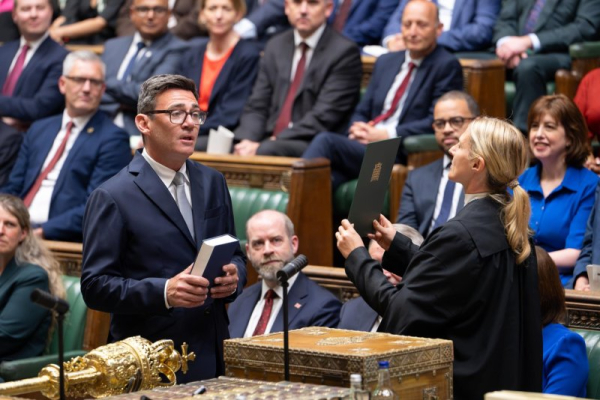
Andy Burnham (L) was set to get the keys to No. 10 Downing Street just 28 days after being sworn in as a Member of Parliament after winning the Makerfield by-election, a seat the sitting lawmaker vacated specifically to enable Burnham to make a run for the prime ministership.File photo by House of Commons/EPA
Newly elected Labour Member of Parliament Andy Burnham was set to become British prime minister uncontested at the beginning of next week after securing unassailable backing from fellow lawmakers.
On Tuesday, with two days of the nomination period for the leadership of the party still to run, the former Mayor of Greater Manchester had the support of 349 Labour MPs, making it a mathematical impossibility for another candidate to overtake him.
Candidates need the backing of 81 Labour MPs minimum to be nominated — equivalent to 20% of the party’s 403 lawmakers — but the level of support Burnham has means insufficient numbers of uncommitted MPs remain to nominate another candidate.
Endorsements he needs from three other affiliated groups, including two trade unions, were expected to be rubber-stamped.
As the lone candidate to replace Keir Starmer, who resigned on June 22 after six years at the helm and two years as prime minister, Burnham, 56, will formally take over as party leader on Friday and become prime minister on Monday.
Burnham increased his support tally from 322 MPs to beyond the threshold at which he could still be challenged after hustings to answer questions from Labour MPs on Monday night with the proceedings held in private.
The former MP and government minister, who quit Westminster politics in 2017 after two failed bids for the leadership of the party while it was in opposition, succeeded at his third attempt, staged via a parliamentary by-election in Manchester just three-and-a-half weeks ago, which he won easily.
Burnham has promised a drastic transfer of power to the regions and to build an efficient state with a “laser-like focus on growth and regeneration,” but has said little else, in part because, with no mandate from the electorate, he is hemmed in by the manifesto that brought Starmer to power in a landslide general election in July 2024.
Starmer was forced out amid falling approval ratings and losses at the ballot box in successive local and by-elections, as well as rebellions by his own MPs forcing policy U-turns, and the debacle over his appointment of Peter Mandelson as ambassador to the United States.
The final straw was a disastrous defeat to Reform UK in “mid-term” local elections in May, prompting defections from his cabinet and growing numbers of MPs calling on him to give way to Burnham, said to be one of the country’s most popular political figures.
Historic July moments through the years
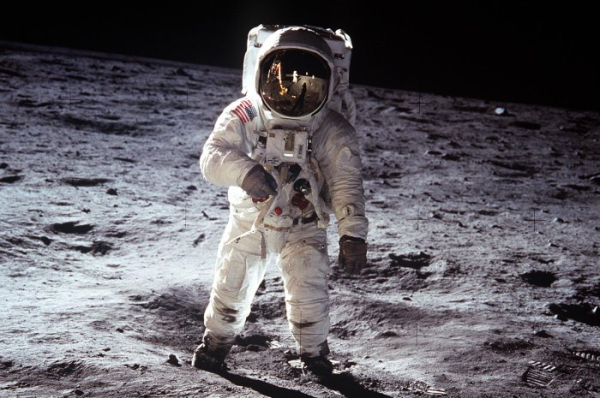
Astronaut Buzz Aldrin walks on the surface of the Moon during the Apollo 11 mission on July 20, 1969. Photo by NASA/UPI | License Photo
