

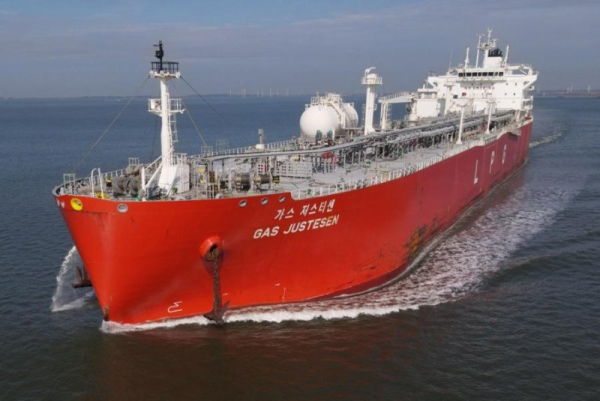
Argentina has authorized private companies to import and sell liquefied natural gas — a move that removes the state from those operations. File Photo by Olivier Hoslet/EPA
The Argentine government authorized private companies to import and sell liquefied natural gas — a move that removes the state from those operations and accelerates the privatization of Enarsa, the country’s public energy company.
The decision was formalized through a decree signed by President Javier Milei and published in the Official Gazette this week. The decree also extends through December 2027 a state of emergency in natural gas transportation and distribution, underscoring continued strain on the system.
Enarsa has historically handled production, transportation and marketing of oil, natural gas and electricity in Argentina. With the new policy, the government begins dismantling that role and shifting functions long overseen by the state to the private sector.
The decision addresses a long-standing structural problem. According to the Secretariat of Energy, Argentina lacks sufficient pipeline capacity to move all gas from producing areas to major urban centers.
That limitation becomes acute in winter. As heating demand rises, domestic supply falls short and the country must import liquefied natural gas by ship.
Until now, the state managed that process. Enarsa bought LNG on the international market at high prices and sold it domestically at well below cost, with the gap covered by taxpayer-funded subsidies.
“This change is part of the decision to move forward with privatizing Enarsa’s assets and activities and to remove the state from its role as an entrepreneur and intermediary in the energy market,” the Energy Secretariat said.
Officials said the state should focus on regulating the market, ensuring clear rules, promoting competition and guaranteeing supply rather than directly buying and selling gas.
Under the new framework, Enarsa will stop importing and marketing LNG, and private operators will take over under a competitive scheme.
The system eliminates the implicit subsidy that existed until now and transfers the entire operation to the private sector, subject to competition rules and state oversight.
To implement the plan, the government will sell access to the Escobar terminal on the outskirts of Buenos Aires. It is the country’s only operational facility where imported LNG is regasified for distribution.
The Secretariat of Energy will set the tender conditions. If no bids are received or the process fails, Enarsa may intervene temporarily to avoid supply disruptions.
Because only one terminal is operating, the government also said it will set a maximum gas price for the upcoming winter to prevent abuse of a dominant position.
Juan José Carbajales, a former undersecretary of hydrocarbons, told UPI that privatization basically means giving a private company the job of buying LNG shipments and then selling that gas inside Argentina.
He said the operation is purely commercial and does not include physical management of the Escobar terminal.
“The scheme will be based on requests the awardee receives from power generators and gas distributors, and sales will be capped by a maximum price set by the Energy Secretariat at least for the next two periods,” Carbajales said.
He said the decision reflects the government’s view that the function failed under state management — a stance rooted in broader distrust of public-sector economic activity, in this case Enarsa.
He said the position is ideological and supported by the so-called Bases Law, which prioritizes private initiative in the economy.
The former official added that large budget allocations to Enarsa did not prove a system failure, but rather a political decision by successive administrations to channel residential gas subsidies by buying fuel at international prices and selling it domestically at far lower levels.
He said the measure also aligns with reforms in the electricity market aimed at gradually returning to a system of free contracting between supply and demand.
Carbajales warned gas prices in Argentina could rise if international conditions push LNG costs higher.
“Although the government will cap that value for two years, uncertainty will remain about what happens once the ceiling is lifted,” he said.
The authorization for private companies to import natural gas is part of a broader privatization agenda promoted by Milei. Since taking office in December 2023, his administration has moved to sell or prepare for sale several state-owned companies.
