


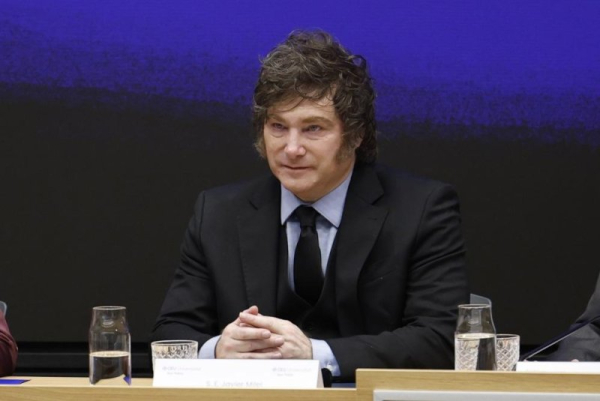
Argentine President Javier Mile said oil, gas and mining sectors could become new engines of economic growth beyond the country’s traditional reliance on agriculture. Photo by Chema Moya/EPA
President Javier Milei said Argentina is undergoing a shift in its productive structure, and that the oil, gas and mining sectors could become new engines of economic growth beyond the country’s traditional reliance on agriculture.
Milei made the remarks during a speech before business leaders at the Buenos Aires Stock Exchange during the institution’s 172nd anniversary celebration.
His comments came as his administration seeks to show signs of economic recovery and attract private investment to sectors it considers strategic.
Milei said the desire to create new business opportunities has expanded the number of sectors capable of driving Argentina’s economy, and that reduced state intervention created room for new investment.
“For there to be cash flow, there have to be business opportunities. As we reduced the burden of the state on law-abiding Argentines, new business opportunities began to emerge,” he said.
Milei said that for much of the country’s economic history, development had been tied primarily to agriculture. However, he said that reality has begun to change with the growth of other industries.
“The engine of development is not limited to agriculture and livestock,” Milei said, adding that energy has become one of the sectors with the greatest potential to drive Argentina’s economy.
The president highlighted the expansion of natural gas and oil production, a sector led in recent years by Vaca Muerta, the formation in Neuquén province that contains vast unconventional hydrocarbon reserves.
Alongside energy development, Milei identified mining as another pillar that could reshape Argentina’s productive structure.
He specifically highlighted the potential of copper, whose international demand has increased because of its importance in industries such as power grid manufacturing, electric vehicles and technologies related to the energy transition.
During his speech, he compared Argentina’s mining development with that of Chile, one of the world’s leading copper producers.
“In Chile’s case, it exports $60 billion, while we export only $5 billion, and we have 70% of the mountain range,” he said.
Milei argued that the difference between the two countries stems from economic decisions made over decades, and he criticized restrictions that he said limited private investment in Argentina.
“We must have done something wrong, and … for 100 years, we kept trampling on private property,” he said.
The performance of the state-controlled oil company was also reflected in financial markets. Argentine outlet Iprofesional reported that YPF shares rose above $55 per share, reaching their highest level in more than a decade.
The company came close to a market capitalization of $22 billion, a level it had not reached in about 15 years.
Milei rejected the idea that the current recovery was the result of the company’s nationalization in 2012 under the administration of Cristina Fernández de Kirchner.
“Don’t tell me this was the result of nationalizing YPF, because YPF shares were worth $3 at that time, and today they are worth 15 times more,” he said.
Political scientist and financial adviser Gastón Lentini said YPF has become a central element of the country’s economic expectations.
“Today, YPF is the main engine of Argentina’s energy sector and economy. The expectation of higher future profits is what attracts investors, both domestic and foreign,” Lentini told UPI.
He also highlighted the role of Horacio Marín, YPF’s president and chief executive officer, who took over the company with a strategy focused on increasing production and expanding investment.
“Marín explains the company’s future plans, looking ahead to 2030 and 2031, in a way that is very clear for everyone,” he said.
According to Lentini, one of the company’s objectives is to maintain access to financing to continue its expansion projects. That strategy, he said, is already being reflected in higher levels of oil and natural gas production.
“YPF is reaching levels of energy production and sales that would have been unthinkable 10 years ago,” he said.
He said the company has begun to explore new businesses related to electricity generation, while the government’s economic policies have made it easier for private companies to participate in infrastructure projects.
Among those projects, he cited construction of natural gas pipelines and oil pipelines needed to transport the products from extraction sites to domestic consumption and export markets.
Lentini said YPF’s current valuation reflects several factors that go beyond Argentina’s domestic situation. Among them, he cited the international environment shaped by armed conflicts, high energy prices and rising electricity demand associated with development of new technologies, such as artificial intelligence.
“Those factors lead the market to project higher energy prices over the coming months,” he said, adding that prices appearing high today could be viewed differently if international conditions continue to favor the sector.
“These prices that seem high today may be considered an opportunity in one or two years,” he said.
Milei’s remarks were part of his administration’s strategy to show that Argentina’s economy can rely on a broader range of productive activities.
Under that approach, the government seeks to position the country as a significant supplier of energy and minerals to international markets, while complementing the country’s historic agricultural sector with the development of oil, natural gas and mining.
