

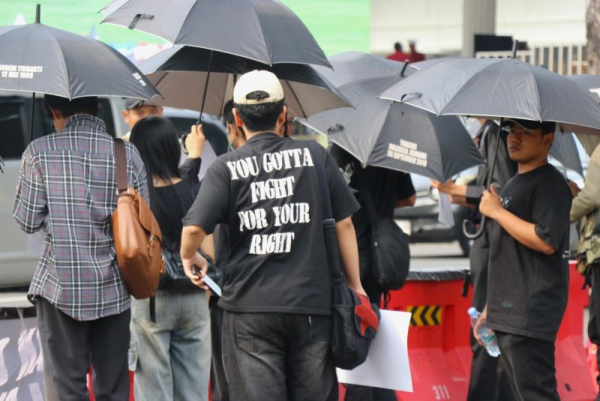
1 of 8 | Protesters hold black umbrellas, with one wearing a shirt that reads “You gotta fight for your right,” at the weekly Kamisan demonstration in Jakarta, Indonesia, on Thursday. Photo by Bridget Erin Craig/UPI
Days before Indonesia’s 80th Independence Day, protesters last week in Jakarta gathered to voice concern over the government’s efforts to reshape the nation’s official history through state-sponsored textbooks, and to demand accountability for activists who have been missing since 1998.
Indonesia marked Independence Day on Sunday, but the Kamisan protesters underscored that true freedom is incomplete without justice, accountability and an honest reckoning with the nation’s past.
“This is not just a regular peaceful action. This is part of our commitment as a civil society when we show up every week here,” Nutrina Savitri said. “It shows we are not afraid, you [the government] might repress us, but we will not back up.”
Every Thursday afternoon since Jan. 18, 2007, protesters have gathered in front of the State Palace in Central Jakarta. They plan to continue their weekly day of action until the government addresses and resolves past cases of human rights abuses in Indonesia.
The demonstration by those affiliated with the Kamisan Movement was just one of more than 900 national weekly protests, also known as “Kamisan,” That is derived from the Indonesian word “Kamis,” which means Thursday. Kamisan refers to something that happens on Thursdays.
The student protesters of the Reformasi Era in the late 1990s chose Thursdays for their gatherings as a way to confront officials before leaving for the weekend.
“It’s a weekly peaceful action here in Jakarta held by victims of past abuses. This year the Kamisan vigil enters its 18th year, so what they demand is justice for victims of past abuses,” said Nurina Savitri, campaign manager at Amnesty International Indonesia. “They have been doing this every week for 18 years and do it on purpose in front of the presidential palace.”
Every week, the protest focuses on a different aspect of human rights abuses and tragedies Indonesians have experienced throughout their history, from anti-communist purges in the 1960s to ongoing abuses in Papua and Aceh, emphasizing that Indonesia’s struggle for justice is ongoing.
Last week’s demonstration emphasized opposition to the Indonesian government’s attempt to reshape the country’s official history through a new 10-volume set of state-commissioned textbooks, which critics argue sanitize Indonesia’s past by downplaying human rights abuses and political violence. Originally set to be released Sunday, the release has been postponed until Nov. 10.
“Each Thursday, they have a different team. It depends on what they are advocating. For example, today, the government is trying to rewrite the history with their version without asking the victims of 1998,” said Muhammad Alfathir, recent graduate from the University of Indonesia and intern at Amnesty International. He has been attending the protests for almost four years.
In the most recent protest, hundreds of people trickled in and out throughout the afternoon’s events. Many carried signs and wore shirts showing their opposition, but what stood out most were the black umbrellas that the majority of demonstrators held.
Alfathir related the event’s larger turnout to the campaign coordinators inviting local artists to perform and paint murals live, given Indonesia’s 80th anniversary on Sunday.
Protesters typically carry black umbrellas — a symbol of mourning and resistance — to reinforce their firm stance about the government’s lack of action, with participants facing away from the State Palace so that the umbrellas can be seen from the palace.
Given Jakarta’s tropical climate, protesters also use the umbrellas to protect from harsh heat and rain.
The Indonesian protesters were inspired by the Mothers of the Plaza de Mayo, in Buenos Aires, who marched for years to determine what happened to their missing children during the Argentine Dirty War in the 1970s to 1980s.
In 1998, Indonesian students led mass protests challenging former President Haji Mohammad Suharto’s authoritarian rule, the military’s political influence and replacement of the People’s Consultative Assembly as the superior legislative power over the House of Representatives.
These protests resulted in the death of 17 students and the disappearance of 13 others, along with many injuries — but zero accountability for the perpetrators.
The Kamisan protesters’ concerns come as Indonesia debates how to remember its past. Alfathir said Kamisan helped him reconnect to the country’s history.
“I felt what they did here for 18 years really motivates me to learn about our history that has been removed from the government,” he said.
The government is currently overseeing a major initiative to revise the nation’s official history, with the Indonesian Historians Society leading the effort under the auspices of the Ministry of Culture.
Officials contend that the updated narrative will be more relevant for younger generations by eliminating colonial bias and incorporating recent developments.
Indonesians feel that new history books already omit or downplay key events, and they fear new ones will deepen the issue, including human rights abuses under Suharto’s 32-year rule and the mass rapes that occurred during the 1998 riots.
Culture Minister Fadli Zon has dismissed reports of the 1998 mass rapes as “rumors,” most recently in an Indonesian Times podcast, Zon, on June 11, therefore fueling accusations of historical revisionism.
For Kamisan protesters, the fight is clear: Rewriting history is not just academic. It is a matter of justice, accountability and remembering those who disappeared or suffered.
“We are preparing some judicial steps that I cannot announce now because we are still drafting,” Savitri said.
Indonesia’s most recent election was held Feb. 14, 2024, resulting in the victory of Prabowo Subianto as president and Gibran Rakabuming Raka as vice president. Subianto is affiliated with the nationalist, right-wing populist Gerindra Party, while Raka ran as an independent.
Similar to the United States, the Indonesian government is composed of three branches — executive, legislative and judicial — with cabinet positions appointed by the executive. The presidency and vice president serve five-year terms.
With black umbrellas raised against the State Palace every Thursday, the Kamisan protesters signal that the struggle for truth, justice and accountability in Indonesia is far from over. As new official histories are written, they hope these weekly demonstrations ensure that the voices of the past remain audible.
