


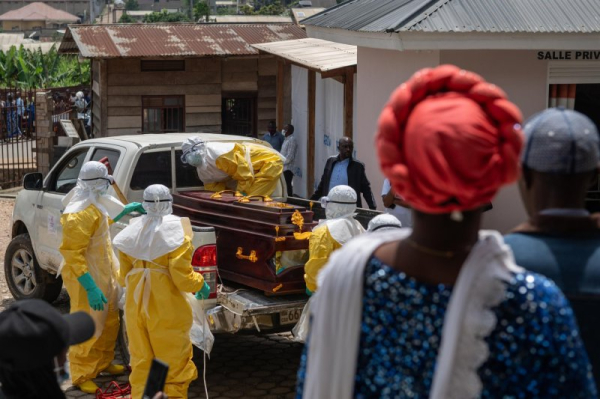
The Bahamas, Canada and Thailand on Tuesday imposed travel restrictions affecting travelers from Ebola-hit the Democratic Republic of Congo and Uganda, as well as neighboring South Sudan. File Photo by EPA
The Bahamas, Canada and Thailand are imposing travel restrictions on travelers from Ebola-stricken regions, as the International Rescue Committee warns that the outbreak could worsen.
All three countries instituted restrictions Tuesday, mostly focused on the admission of travelers from regions battling the Bundibugyo virus strain of Ebola.
The Democratic Republic of Congo has been the epicenter of the epidemic, where the first suspected case was reported on April 24.
Since then, DRC health officials have reported more than 1,000 cases, the vast majority suspected, including 10 confirmed deaths, though there are 119 suspected fatalities. Uganda has reported seven confirmed cases, including one death as of Tuesday.
The World Health Organization declared the outbreak a public health emergency of international concern on May 17.
Of the three nations, Canada was implementing the strictest restrictions, mandating that all arrivals who have visited either the Democratic Republic of Congo, Uganda or South Sudan in the last 21 days quarantine for 21 days, starting Sunday.
Ottawa was also suspending immigration documents, including previously approved permanent and temporary resident visas, for residents of those countries for the next 90 days, starting late Wednesday.
“The health and safety of people in Canada is our top priority,” Health Minister Marjorie Michel said in a statement.
“These temporary border measures will help reduce the risk of Ebola disease entering the country while ensuring that travelers are managed based on their level of risk.”
The Bahamas restrictions include enhanced public health screenings for Bahamian nationals who have been present in the Democratic Republic of Congo, Uganda and South Sudan within 21 days of their return home, its foreign ministry said in a statement. Foreign nationals may be subject to the increased screening and possible quarantine or isolation measures if they were present in those three countries within the last 30 days.
And Thailand, which declared the DRC and Uganda “dangerous communicable disease infected zones” effective May 21, imposed a mandatory 21-day quarantine for all travelers arriving from the DRC and Uganda or transiting through the two countries.
The measure is a further restriction compared to the policy imposed May 20, mandating that arrivals from outbreak areas provide the address and telephone details of where they will be staying while in the country for a 21-day monitoring period.
The United States appears to have been the first country to impose restrictions, effective May 18, prohibiting certain non-U.S. citizens from entering the United States if they had been to the DRC, Uganda or South Sudan in the past 21 days. The policy was then expanded days later, applying the restriction to U.S. lawful permanent residents.
Under the policy, an Air France flight en route to the United States was diverted to Canada last week as a passenger onboard had recently been in the DRC.
On Thursday, the International Rescue Committee warned that the DRC outbreak, its 17th since the disease was discovered in 1976, could become the deadliest yet without urgent international action.
“The warning signs are flashing red,” Bob Kitchen, vice president of emergencies for the IRC, said in an emailed statement.
The IRC is basing its warning on the fact that the outbreak is spreading faster than the response is moving, aid cuts have weakened eastern DRC’s health system and conflict in the region is fueling the crisis and raising the risk that the virus could spill into neighboring countries.
“The risks are growing and the resources are shrinking,” Kitchen said. “That is the brutal arithmetic facing global aid today.”
The deadliest Ebola outbreak in the DRC occurred between 2018 and 2020, killing 2,287 people, according to the WHO. The deadliest since the disease was discovered was the West Africa outbreak of 2014 to 2016 that had a death toll of about 11,300.
This week in Washington

Vice President JD Vance speaks during a roundtable on anti-fraud initiatives in the Indian Treaty Room in the Eisenhower Executive Building near the White House on Tuesday. Photo by Bonnie Cash/UPI | License Photo
