


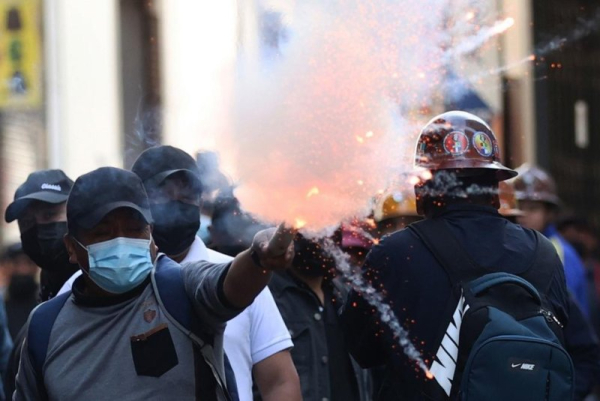
A member of the Bolivian Workers’ Union sets off a firework during a protest against the government’s economic policies in La Paz, Bolivia, on Monday. Photo by Luis Gandarillas/EPA
Bolivia’s largest labor union federation launched a nationwide strike Tuesday, with road and street blockades, as teachers, farmers and Indigenous organizations expanded protests and some leaders began to demand President Rodrigo Paz’s resignation.
The strike, called by the Bolivian Workers’ Central, known as COB, marks a new escalation in the country’s growing political and social crisis after nearly two weeks of protests over fuel shortages, wage demands and opposition to a package of economic reforms promoted by the government.
“The people’s demands have not been addressed to date,” COB said in the directive that formalized the “indefinite mobilized strike.”
The demonstrations began with demands related to diesel supply, fuel quality, wage increases and the repeal of Law 1720 on land classification, but in recent days evolved into broader political demands.
“The people are already tired, all 20 provinces have spoken out, the population has surpassed us, they are fed up with this government and the only demand from the 20 provinces is the resignation of Rodrigo Paz,” said Vicente Salazar, leader of the Túpac Katari Peasant Federation of La Paz, according to Diario Desacato.
Tensions increased after COB formalized an alliance with peasant, Indigenous and intercultural organizations under what union leader Mario Argollo described as a “non-betrayal pact” aimed at unifying the protests.
Argollo accused the executive branch of issuing regulations that benefit certain powerful families, the business class, agribusiness, bankers and millionaires, while “for the people, nothing.”
“If the president is not willing to resolve the situation, he has to go,” Argollo said in remarks published by local outlet Erbol.
The conflict expanded this week with the addition of urban and rural teachers, who suspended classes and called for marches and blockades to demand wage increases, more educational positions and labor improvements.
Miles de docentes urbanos marchan por el centro de La Paz en el paro de 24 horas del magisterio nacional y segunda semana de huelga instruida por la Central Obrera. @teleSURtv pic.twitter.com/WzPpC5kmyo— Freddy Morales (@FreddyteleSUR) May 11, 2026
Education Minister Beatriz García called for dialogue with teachers and asked that educational continuity be prioritized, Infobae reported.
“A lost school day cannot be recovered,” Garcia said while announcing a meeting with sector representatives.
The Bolivian Highway Administration reported Monday seeing at least 34 blockade points on key highways connecting La Paz with other regions of the country and border crossings into Peru, affecting the transportation of food, fuel and passengers.
Local media reported shortages of basic goods, disruptions to national and international transportation and hundreds of tourists stranded in different regions of the country.
Bolivian authorities announced an air evacuation of nearly 300 Peruvian citizens trapped by the blockades. The Ministry of Sustainable Tourism, Cultures and Folklore estimates daily losses at close to $3 million.
The protests also took on a strong ideological component after announcement of a package of 10 laws promoted by Paz related to hydrocarbons, mining, electricity, investments, green economy measures and reductions to the state apparatus.
Paz conended the reforms are necessary to modernize Bolivia’s economy and attract foreign investment. However, unions and Indigenous movements believe the measures threaten the economic model promoted during the government of former President Evo Morales, which was characterized by greater state participation in strategic sectors.
Union leaders described the proposals as “shock packages” aimed at privatizing key sectors, such as energy, water and education.
“The president is not going to resign. What do they want, for him to leave by force?” Public Works Minister Mauricio Zamora said, accusing protest groups of attempting to destabilize the government.
Authorities reiterated calls for dialogue after clashes last week in downtown La Paz, where police used tear gas to remove protesters who occupied offices at the Ministry of Labor. Thirteen people were detained during those incidents.
Despite official calls for dialogue, COB reiterated that it does not recognize Labor Minister Édgar Morales as a valid interlocutor and said the protests will continue indefinitely until its demands are met.
