


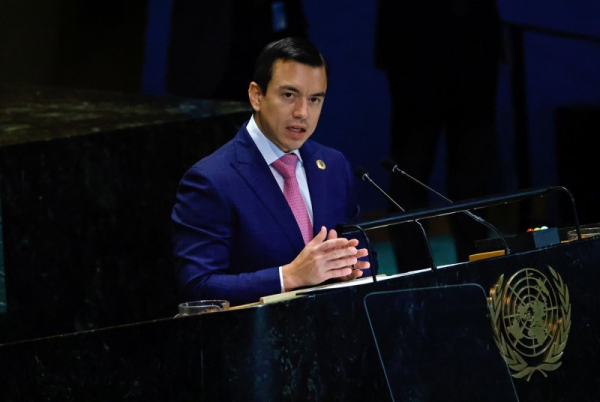
Daniel Noboa Azin, Constitutional President of the Republic of Ecuador, speaks at the ‘Summit of the Future’ during the UN General Assembly 79th session in UN General Assembly Hall at the United Nations Headquarters on Monday, September 23, 2024 in New York City. Photo by Peter Foley/UPI | License Photo
Ecuadorian President Daniel Noboa accused Colombia’s government of backing a guerrilla incursion along the northern border, a claim rejected by Colombian President Gustavo Petro, as more than 15,000 troops were deployed in the area to contain drug trafficking threats.
“Several sources have informed us of an incursion along the northern border by Colombian guerrillas, driven by the government of Petro,” Noboa said Wednesday on X, where he also said Ecuador would protect its territory and population.
Petro responded directly to the Ecuadorian leader and denied the accusations.
“Go to the northern border and you will meet me there and we will build peace in those territories. Stop believing lies,” he wrote.
This week Petro also leveled accusations against his Ecuadorian counterpart, whom he accused of interference in Colombia’s presidential campaigns to favor right-wing candidates ahead of the May 31 election.
The exchange comes as Colombia strengthens its military presence along the border with Ecuador.
Defense Minister Pedro Sánchez said Thursday that more than 15,000 personnel have been deployed in the departments of Nariño and Putumayo, along the 364 miles of shared land border.
According to the official, the operation includes six aircraft, eight armored platoons and 16 maritime and river units, aimed at ensuring security, curbing arms trafficking and combating drug trafficking structures.
Last weekend, in southwestern Colombia, an assault along the Pan-American highway left 21 people dead and dozens injured, on one of the region’s most strategic routes for trade and mobility.
Petro suggested that the explosives used in that attack came from Ecuador.
Sánchez said the operations seek to “protect life, territory and national sovereignty” and that permanent Army and police checkpoints will be maintained to prevent smuggling and the expansion of illegal armed groups.
The Colombia-Ecuador border has historically been an area of high activity for criminal organizations linked to drug trafficking, with corridors used for the movement of drugs, weapons and other illicit economies.
Ecuador has implemented a hardline policy against crime, but violence has not eased. The country is among the most unsafe in the region, with a homicide rate of 51 per 100,000 inhabitants in 2025, according to reports by DW.
The Colombian government has stressed the need for international cooperation to address transnational crime, saying the response must be coordinated among neighboring countries.
However, tensions between Quito and Bogotá have also extended into the economic sphere, with recent frictions over trade measures and tariffs.
