

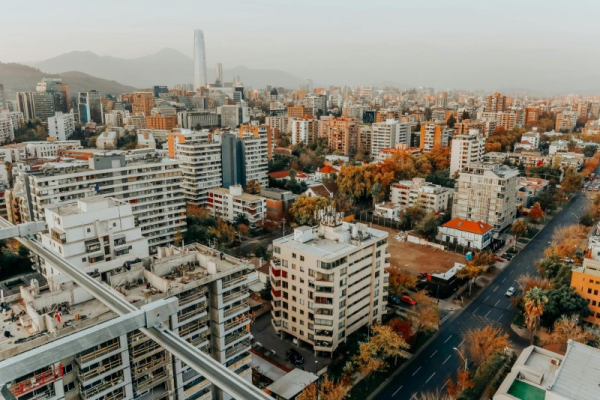
Research identified 1,389 seismic events in southern Santiago, Chile, between 2017 and 2025. Additional records suggest the activity has persisted for more than 30 years. Photo by Alisha Lubben/Pexels
Researchers in Chile have identified a persistent cluster of microearthquakes beneath the capital, Santiago, marking the first documented case worldwide of continuous seismic activity of this kind. It has lasted more than three decades.
The tremors occur at depths between 12.4 and 18.6 miles and typically register magnitudes below 3.0, making them imperceptible to the population, according to the research team.
Unlike aftershocks or activity linked to a major earthquake, the phenomenon is associated with long-term geological processes within the continental plate.
“It is a unique phenomenon. We do not know of another place that has remained seismically active for such a long period,” Leoncio Cabrera, an academic at the Department of Structural and Geotechnical Engineering at Pontifical Catholic University of Chile, told UPI.
The study also included researchers from the University of Chile.
The findings were published in the scientific journal Seismological Research Letters under the study titled “8.5 + Years of Persistent Intraplate Seismicity Beneath Santiago City, Chile.”
The research identified 1,389 seismic events in southern Santiago between 2017 and 2025. Additional records suggest the activity has persisted for more than 30 years.
“Residents do not feel these events because of their low magnitude, but they are detectable by instruments such as seismographs. There have been some magnitude 4 or near 5 events that were likely felt, but most are not,” Cabrera said.
Researchers began to investigate the phenomenon after repeatedly detecting seismic activity each time instruments were installed in the area.
“We wanted to understand why seismicity kept appearing there, and we realized it was not that it appeared intermittently, but that it is always present,” Cabrera said.
The team believes the activity is linked to a type of rock containing fluids that, under pressure and temperature, are released and trigger the microearthquakes.
Cabrera said the discovery provides a natural laboratory for scientists to study how deformation accumulates and is released deep within the Earth’s crust, offering insights into how such seismic activity may evolve.
“In other places with more instrumentation, it has been observed that at certain depths the rate of events is linked to processes such as water cycles. For example, the number of earthquakes can vary between summer and winter,” he said.
He added that persistent seismic activity could provide clues about tectonic energy buildup and the long-term probability of larger earthquakes, underscoring the need for further study.
“These earthquakes are symptoms of processes occurring within the Earth. They provide information on how energy accumulates and is released in different parts of the crust. However, there is no cause for alarm, as their behavior suggests they will continue in the same way,” Cabrera said.
The researcher noted that similar microseismic activity may exist in other parts of the world, but it has not yet been detected because most monitoring systems are designed to capture larger earthquakes.
