

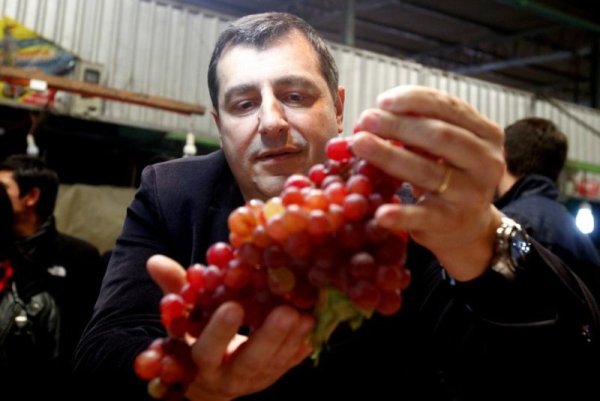
Chile’s table grape industry expects a lower supply to the United States during the peak export month, projecting a 10% decline compared with 2025 as producers continue a shift toward newer varieties and adjust shipments amid market oversupply.File Photo by Sebastian Silva/EPA
Chile’s table grape industry expects a lower supply to the United States during the peak export month, projecting a 10% decline compared with 2025 as producers continue a shift toward newer varieties and adjust shipments amid market oversupply.
Ignacio Caballero, executive director of the Chilean Fruit Table Grape Committee, told UPI the reduction partly reflects ongoing varietal replacement, with traditional grapes being replaced by more competitive ones. He added that excess table grape supply in the U.S. market also is behind the expected decline.
“The 2026 season will be a year of adjustment, consolidating the varietal replacement with new varieties, which this year will account for 72%. Five years ago, only 36% of exported grapes were new varieties,” Caballero said.
Industry projections indicate Chile will export 34.7 million boxes of fresh grapes weighing about 18 pounds each to the United States during the season. The United States accounts for just over half of Chile’s global table grape exports.
Caballero said the global table grape sector is facing a complex time due to oversupply and unimpressive demand.
“There is stagnant demand, market saturation and little investment in increasing demand through promotions. It is a moment when the industry must be proactive and change the trend,” he said.
He noted the United States remains the world’s main table grape market, but is currently facing a situation in which supply exceeds demand. Weekly demand has remained stable for years between 3.5 million and 4 million boxes, he said.
Rafael Rodríguez, president of industry group Uvanova, told Portal Frutícola that the share of Chilean fruit shipped to the United States is lower than at the same time last year as part of a more balanced distribution strategy.
“It is key not to exceed 3.5 million to 4 million boxes per week to the United States and to support that volume with well-planned promotions, as is already being seen in retail,” Rodríguez said.
He added exporters are also seeking not to exceed shipments from Peru, particularly in January when Peruvian grapes peak, while Chile’s main export period occurs in February.
This adjustment in shipments is also linked to the need to offer more competitive table grape varieties that align with U.S. consumer preferences.
“Consumer tastes have changed significantly in recent years. Red varieties were once the most consumed, but now green grapes are preferred,” Rodriguez said.
Seedless grapes are also increasingly favored because they are crunchier, larger and sweeter.
“There are currently more than 80 grape varieties, offering different options for consumers,” he added.
Rodríguez said the global grape basket now consists of about 50% white seedless grapes, 45% red grapes and less than 5% black grapes. He said Chile is achieving a more balanced and competitive varietal mix.
To increase demand, Chile joined Peru and Mexico in forming the Global Grape Group to promote consumption through joint initiatives such as the “Have a Grape Day” campaign. Caballero said table grapes historically received less promotional investment than products such as avocados or berries, leaving room to expand demand.
Supply from these countries has increased 41% in the United States over the past eight years, while demand grew only 3%, contributing to price declines below $18 per box.
“We want to increase consumption, but also exchange weekly information and share best sustainability practices among ourselves. Meetings have already been held with other origins to invite them to join, such as Brazil, South Africa, California and Murcia. Other stakeholders, including importers and others with significant importance in the grape industry, are also being invited,” he said.
For the 2026 season, the Chilean Fruit Table Grape Committee expects exports of 63.5 million boxes worldwide, a 6.6% decrease from the previous season.
Chile was long the leading global exporter of table grapes and remains among the top three worldwide, after Peru and China.
