

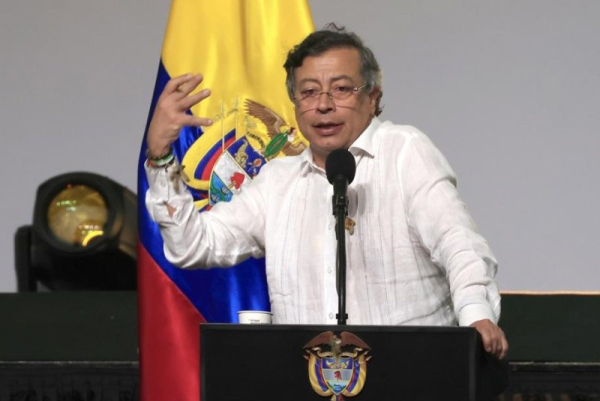
Colombian President Gustavo Petro said his country and Venezuela plan to submit formal applications to join Mercosur after a meeting in Caracas between delegations from the two governments. File Photo by Ricardo Maldonado Rozo/EPA
Colombia and Venezuela said they will seek full membership in the Mercosur trade bloc amid an internal debate within the South American group over how to deepen its integration before a broad trade agreement with the European Union enters into force.
Venezuela joined as a full member in 2012, but was suspended in 2017 after the bloc activated its democratic clause because of the political crisis under the government of Nicolas Maduro.
Colombian President Gustavo Petro said of the weekend that both countries will submit formal applications to join the regional bloc after a meeting in Caracas between delegations from the two governments.
Petro said he also will seek to end the moratorium that keeps Venezuela suspended.
“We will ask that the moratorium be lifted so that Venezuela can enter Mercosur as a full member, and we, as Colombia, will submit a request to enter as a full member,” the Colombian president wrote on the social media platform X.
The announcement came after meetings between officials from both countries to strengthen cooperation in border security, the fight against drug trafficking and energy projects.
Mercosur currently consists of Argentina, Brazil, Paraguay and Uruguay.
Colombia has participated in Mercosur as an associate state since 2004, which allows it to maintain trade agreements with the bloc, but without voting rights in its decisions.
In addition, the governments evaluated broader integration initiatives, including proposals to facilitate mobility between both countries and move toward dual nationality mechanisms for residents of the border region.
The possible expansion of Mercosur comes amid internal pressure to improve its economic functioning before a trade agreement with the European Union becomes effective.
During meetings of the Inter-American Development Bank held this week in Asuncion, Paraguay, officials from bloc countries said Mercosur still faces major obstacles to achieving true economic integration.
One of the main problems is that, unlike the European Union, the South American bloc maintains customs controls and different regulations among its members, which can generate delays in transporting goods and additional costs for companies.
Argentine authorities have proposed advancing toward regulatory convergence and greater coordination between customs agencies as a step before gradually eliminating internal barriers to trade.
Paraguayan President Santiago Peña called for the agreement with the European Union not to be limited to tariff reductions, but also to promote deeper economic integration to improve regional competitiveness and attract investment.
If the members meet the planned timetable, the agreement between Mercosur and the European Union could become effective May 1, creating a combined market of more than 720 million people and nearly a quarter of the world’s economic output.
The possible accession of Colombia and the potential return of Venezuela would add new political and economic dimensions to the bloc just as it seeks to redefine its role in global trade and strengthen its regional integration.
