

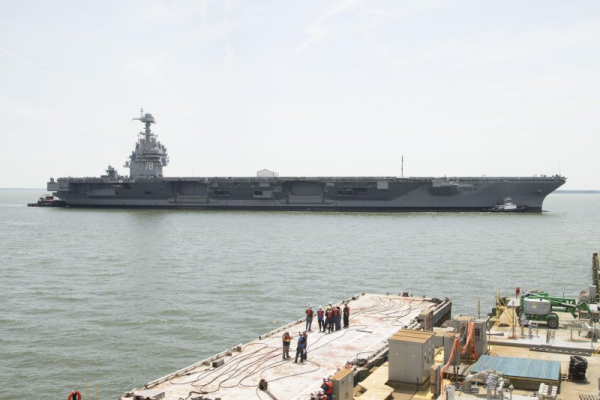
The USS Gerald Ford and its carrier group are off Venezuela and have been involved in attacking suspected drug boats. Photo by Mass Communication Specialist 2nd Class Cat Campbell/U.S. Navy
The family of a Colombian fisherman has filed a formal complaint with the Inter-American Commission on Human Rights over a death attributed to a U.S. military strike on a boat in the Caribbean — a campaign Washington says is part of its operations against transnational drug-trafficking networks.
The petition was filed on behalf of Alejandro Carranza, who was killed Sept. 15 during a U.S. airstrike off the coast of Colombia.
The commission has the power to monitor, investigate and promote human rights across the Americas. It can receive individual petitions, issue precautionary measures to protect people at risk, conduct country visits, publish reports and refer cases to the Inter-American Court of Human Rights, though it does not itself issue binding judgments.
However, should the case advance, the United States does not accept the jurisdiction of the Inter-American Court of Human Rights. The United States signed the American Convention on Human Rights in 1977, but never ratified it.
The filing is supported by Daniel Kovalik, a human-rights attorney who has represented President Gustavo Petro in several international cases, El País reported. Kovalik called for an investigation into responsibility, reparations for damages and a review of the legality of the operations.
The complaint says the strike that destroyed the vessel was an “extrajudicial execution” and assigns direct responsibility to Defense Secretary Pete Hegseth, whose orders allegedly were approved by President Donald Trump.
According to the petition, the United States has carried out more than 20 strikes since early September on vessels it considers linked to drug trafficking, leaving more than 80 people dead and only three survivors.
Washington maintains the actions comply with the Law of Armed Conflict and that the targets are part of criminal organizations that pose a direct threat to U.S. national security.
Carranza’s family said the fisherman had gone out to do his usual work and that his boat had sent a distress signal before the strike.
They said they identified the boat in footage recorded that day, where it appeared in flames after the missile strike. They also said Carranza had no ties to drug-trafficking networks, El Colombiano reported.
Colombian President Gustavo Petro wrote in an Oct. 8 post on X that “a new theater of war has opened: the Caribbean. Evidence shows that the last boat bombed was Colombian, with Colombian citizens on board. I hope their families come forward and file complaints.”
In early November, Petro posted a photograph showing him meeting with the fisherman’s children.
“A very poor family living in the poorest neighborhood of Santa Marta. They are neither terrorists nor drug traffickers. Rubio and Trump are completely wrong,” he wrote on X.
The filing before the Inter-American Commission on Human Rights says Hegseth ordered the strikes on vessels without knowing the identity of those on board. It adds that Trump justified the actions as part of a strategy against drug-trafficking groups in the region.
In a press release, the commission expressed concern over the extraterritorial use of lethal force and said every state must guarantee the right to life and due process, even during military operations outside its borders.
The commission urged the United States to refrain from using lethal military force in public-security operations, ensuring that any security or anti-crime action fully complies with international human-rights standards.
It also called for prompt, impartial and independent investigations into all deaths and detentions resulting from these actions, as well as effective measures to prevent their recurrence.
Female presidents who shaped Latin America
Violeta Chamorro, NicaraguaPresident-elect of Nicaragua Violeta Chamorro makes victory signs after attending Sunday service in Houston on March 11, 1990. Chamorro was the first woman elected president of Nicaragua and the first female president in the Americas. She led the country from 1990 to 1997 following the end of the Contra War. Photo by George Wong/UPI | License Photo
