

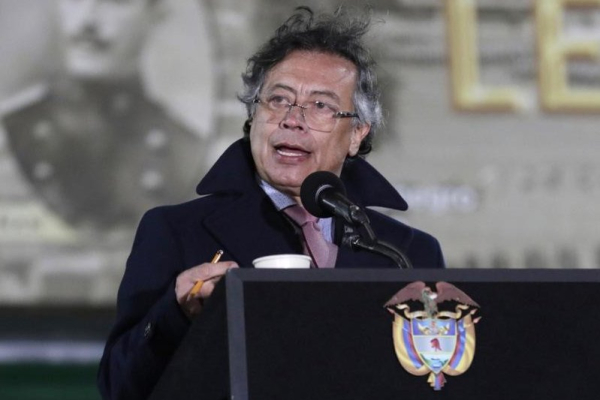
Colombian President Gustavo Petro said he requested intervention by U.S. President Donald Trump to prevent an escalation of the conflict with Ecuador. File Photo by Carlos Ortega/EPA
Colombian President Gustavo Petro said authorities found an active explosive device near the border with Ecuador that may have been dropped from an aircraft, suggesting the incident could be linked to attacks that originated in Ecuadorian territory.
Ecuador’s government rejected that possibility.
During a Cabinet meeting Monday, Petro said the discovery is under investigation and could point to a pattern of incidents in the border area.
“A bomb has appeared that was dropped from an aircraft. The methods will be thoroughly investigated. Very close to the border with Ecuador,” Petro said Tuesday on social media.
#URGENTE El presidente de #Colombia, @petrogustavo, denunció el hallazgo de una bomba que habría sido lanzada desde un avión en una zona muy cercana a la frontera con #Ecuador. Afirmó que "están bombardeándonos desde el Ecuador" y que los responsables no son los grupos armados… pic.twitter.com/9ejaGkpLzD— Ecuador En Directo (@EcEnDirecto) March 17, 2026
“This somewhat confirms my suspicion, but it must be investigated carefully: that they are bombing us from Ecuador and that these are not armed groups,” he added.
Petro said multiple explosions have been recorded in recent days, adding that his government has received material that supports his claim.
“There have already been many blasts, and there is a recording that I believe should be made public. We did not produce it, because it comes from Ecuador, and there is something unusual,” he said.
Petro also said he requested intervention by U.S. President Donald Trump to prevent an escalation of the conflict.
“I asked Trump to act and call the president of Ecuador because we do not want to go to war,” he said.
From Ecuador, Foreign Minister Gabriela Sommerfeld rejected the accusations and said the country’s military operations are carried out exclusively within its own territory, as part of efforts to combat armed groups and drug trafficking organizations.
Ecuadorian President Daniel Noboa rejected the claims in a post Tuesday on X, where he defended his government’s military operations and questioned Petro.
“President Petro, your statements are false; we are acting in our territory, not in yours,” Noboa wrote.
Noboa said his government is “bombing the places that served as hideouts for these groups,” referring to structures linked to drug trafficking, and maintained that many of these groups are of Colombian origin.
Desde el primer día hemos combatido al narcoterrorismo en todas sus formas: a los que operan en las calles y a los que, desde la política o incluso desde la función judicial, se prestan para proteger a los delincuentes.
Hoy, junto a la cooperación internacional, continuamos en…— Daniel Noboa Azin (@DanielNoboaOk) March 17, 2026
Noboa also accused Colombia of allowing criminal organizations to infiltrate through its border and said Ecuador will not back down from its security strategy.
The statements reflect a growing escalation of tensions between the two governments in recent weeks amid a deterioration in bilateral relations.
The dispute intensified in January, when Noboa announced a 30% “security tariff” on Colombian imports, citing a lack of cooperation from Colombia in combating drug trafficking along the border.
Colombia responded with tariffs on 73 Ecuadorian products and suspended electricity supplies, prompting Ecuador to adjust tariffs linked to transporting Colombian crude oil through its energy infrastructure.
The Ecuadorian levy was later raised to 50% as of March 1.
At the same time, Ecuador has strengthened security cooperation with the United States, including the opening of a Drug Enforcement Administration office in Quito and the development of joint operations against armed structures linked to drug trafficking within its territory.
Petro framed the situation within a global context of increasing use of weaponry and warned of the risks of escalation.
