


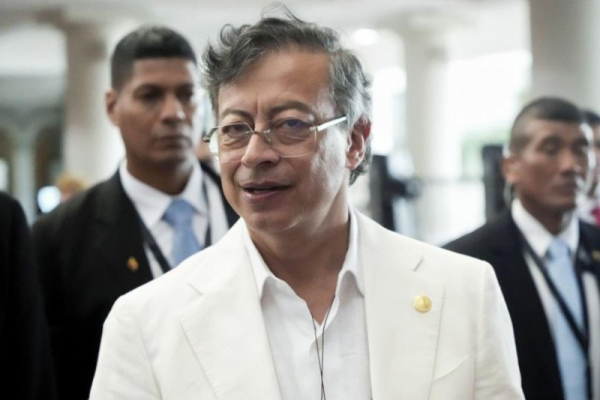
Outgoing Colombian President Gustavo Petro (shown) has barred President-elect Abelardo De la Espriella from holding his inauguration at a military base. Photo by Aris Mariota/EPA
Outgoing Colombian President Gustavo Petro has barred President-elect Abelardo De la Espriella from holding his inauguration at a military base, triggering an unprecedented institutional dispute that has clouded the transfer of power and underscored the country’s deep political polarization.
Citing his authority as commander-in-chief of the armed forces until Aug. 7, the leftist president blocked De la Espriella’s plan to take the oath of office before military personnel.
The incoming government had sought to use the ceremony to signal a sharp break with the outgoing administration’s security policies.
“Military and police barracks are under my command until the new president is sworn in and, therefore, until that moment I am the supreme commander of the military forces,” Petro wrote on X.
Cómo dije, en medio de las lentejuelas del nuevo gobierno no votado por la mayoría del pueblo, la ley dice cuál es la sede del Congreso, y es en una sesión del Congreso donde el nuevo presidente debe posesionarse, tal como lo hice yo y todos los demás.
Que Abelardo no me de la… https://t.co/trc9VqxyxR— Gustavo Petro (@petrogustavo) July 13, 2026
In the post, Petro reiterated his claim that the incoming government “was not elected by a majority of the people,” adding that Colombia’s next president must take office during a full session of Congress “under the laws of the republic and the Constitution.”
Petro’s decision comes amid an institutional crisis and a fractured transition following the June 21 runoff election. After De la Espriella’s victory, Petro alleged electoral fraud and refused to openly recognize the legitimacy of the president-elect.
In response, De la Espriella unilaterally suspended the administrative transition process, accusing Petro of planning a coup to remain in power. International organizations and electoral authorities have validated the election, but the official transfer of information remains frozen.
De la Espriella campaigned on a “tough-on-crime” platform and promised to restore “honor and dignity” to the armed forces, arguing that they had been mistreated and demoralized by the outgoing leftist government’s policies. His request to take the oath of office at a military installation was intended as a symbolic tribute to the troops.
The confrontation highlights Colombia’s sharp political shift after four years under the first leftist government in the country’s history.
According to local media, De la Espriella’s push to hold the congressional session outside the National Capitol also tests his strength against the legislative branch.
Because his party will not hold an absolute majority in the new Congress, which takes office July 20, Petro’s veto highlights the early institutional challenges and opposition the incoming government is likely to face.
