

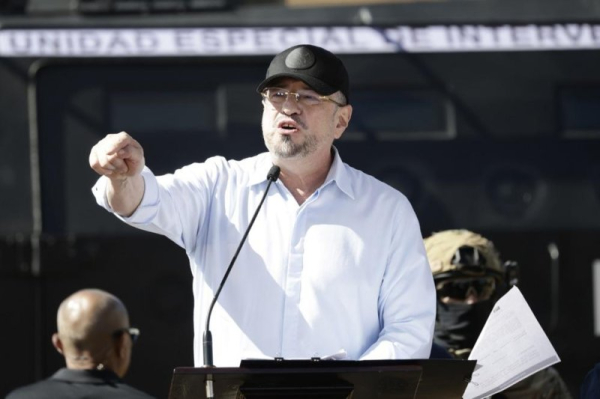
Costa Rican President Rodrigo Chaves announced the decision to sever relations with Cuba Wednesday from the presidential palace alongside U.S. Ambassador Melinda Hildebrand. File Photo by Jeffrey Arguedas/EPA
Costa Rica has formally severed diplomatic relations with Cuba, marking a sharp escalation in regional tensions and following a similar move earlier this month by Ecuador.
President Rodrigo Chaves announced the decision Wednesday from the presidential palace alongside U.S. Ambassador Melinda Hildebrand. He said the move was based on ideological principles and human rights concerns.
Chaves said his administration does not recognize the legitimacy of what he called the island’s “communist regime,” according to Costa Rican newspaper El Mundo.
“We must rid the hemisphere of communists,” Chaves said, arguing that Cuba’s political system has failed and produced “mistreatment, repression and undignified conditions” for its people.
He said maintaining diplomatic ties with Havana was incompatible with the democratic values Costa Rica promotes internationally.
Foreign Minister Arnoldo André Tinoco said the rupture is operational, not symbolic. Costa Rica ordered the withdrawal of all diplomatic personnel from Cuba, and Cuban diplomats in San Jose must leave the country by the end of March, digital outlet Delfino reported.
Tinoco said a minimal consular channel will remain in place to handle basic citizen services. Administrative matters for Costa Ricans in the region will be managed through the country’s embassy in Panama.
He said the decision also reflects what he described as the sustained deterioration of civil liberties in Cuba and the government’s inability to provide basic services, such as electricity and water — factors he said have fueled migration pressures across the region.
In October, Costa Rica signaled a policy shift when it abstained for the first time in years from a U.N. General Assembly vote condemning the U.S. embargo on Cuba. It joined 12 nations, including Ecuador, Paraguay and Argentina, that declined to support the resolution.
Cuban President Miguel Díaz-Canel rejected Costa Rica’s decision to end ties, saying it downgraded relations to a consular level without justification.
“It is an unfriendly act that responds to evident pressure from the U.S. government as part of its renewed offensive to try to bring other countries into its failed policy against Cuba,” Díaz-Canel wrote on X.
Rechazamos la decisión unilateral del gobierno de #CostaRica, de rebajar el nivel de las relaciones con #Cuba, limitándolas al ámbito consular, sin argumento ni justificación alguna.
Se trata de un acto inamistoso, que responde a evidentes presiones del gobierno de EE.UU, como…— Miguel Díaz-Canel Bermúdez (@DiazCanelB) March 18, 2026
Cuba’s Foreign Ministry, in a statement, condemned what it called “servility” toward the administration of President Donald Trump.
“The Ministry of Foreign Affairs of Cuba categorically rejects the disrespectful statements made by President Rodrigo Chaves Robles when, in attempting to justify this unfriendly act, he crudely manipulated Cuba’s history and reality,” the statement said.
It added that Costa Rica “scandalously ignored the direct responsibility of the United States blockade in worsening Cuba’s economic situation and deteriorating living conditions.”
Havana said the decision was “arbitrary, evidently adopted under pressure and without consideration for national interests and those of that brotherly people.”
Costa Rica is the second country in the region to break ties with Cuba this month. In early March, Ecuador expelled the Cuban ambassador and diplomatic staff and withdrew its own envoy from Havana.
President Daniel Noboa said Cuban representatives were engaged in interference, a claim Havana denied while accusing the United States of exerting pressure.
