

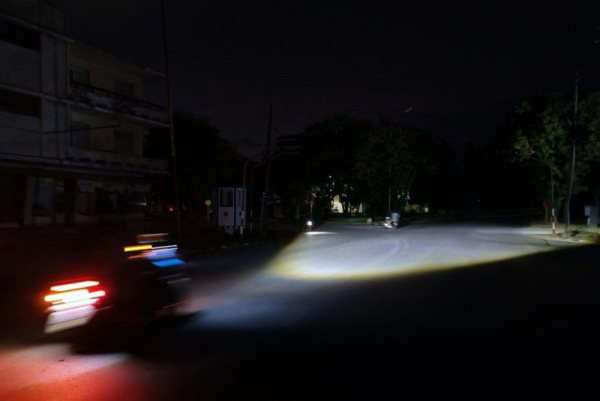
A motorcycle travels down an unlit street during a power outage in Havana in early March. Widespread power outage are continuing throughout the nation as fuel runs out. Photo by Ernesto Mastrascusa/EPA
Cuba entered its 10th consecutive day of protests Monday as demonstrations against power outages, water shortages and worsening living conditions intensified after the government’s confirmation last week of talks with the United States.
Residents in several Havana neighborhoods banged pots and pans, erected improvised barricades and burned trash overnight Sunday and into early Monday. Activists and social media influencers reported detentions and a heavy security presence around official buildings.
Protesters said they are frustrated by more than two weeks of rolling blackouts and, in some areas, several days without running water, according to independent outlet Diario de Cuba.
The unrest escalated after President Miguel Díaz-Canel acknowledged that his government is holding conversations with the United States to address longstanding differences between the two countries, amid a deepening energy crisis on the island.
In the central city of Morón, demonstrators stormed and set fire to the local headquarters of the Communist Party of Cuba, according to Noticias Cubanet. The outlet reported that hundreds of people, most of them young, removed files, computers and furniture from the building and burned them in the street.
France24 reported that five protesters were detained. They had complained about constant blackouts and difficulty accessing food and basic supplies.
Díaz-Canel wrote on X that the public’s frustration over prolonged outages is “understandable,” describing them as a consequence of what he called a U.S. energy embargo that has been “cruelly intensified in recent months.”
He said complaints and demands are “legitimate,” but must be expressed “with civility and respect for public order.”
“What will never be understandable, justified or accepted is violence and vandalism that threatens public tranquility and the security of our institutions. There will be no impunity for vandalism and violence,” he wrote.
Cuban journalist José Raúl Gallego said on social media that activists reported a strong deployment of security forces in several cities overnight.
Gallego shared video footage showing police patrols and vehicles circulating through darkened Havana streets during blackouts.
“This happens every night, all over Cuba. Patrol cars, trucks and special forces vehicles with long guns patrolling the streets to intimidate the population,” he said.
Analysts have described the current demonstrations, which began in Havana and have spread to central provinces, as the most significant since the historic July 11, 2021, protests.
On that day, thousands of Cubans took to the streets in the largest wave of anti-government protests in decades. Chants of “Liberty” and “Homeland and Life” echoed across the island. Security forces quickly dispersed the demonstrations and carried out mass arrests.
Human rights organizations estimate that between 1,000 and 1,500 people were imprisoned after those protests. The government said those convicted were sentenced for crimes including public disorder and vandalism.
According to the Cuban Electric Union’s daily report, the national power grid was expected to face a 1,930-megawatt deficit Monday, meaning about 61% of the island could be without electricity at night.
