


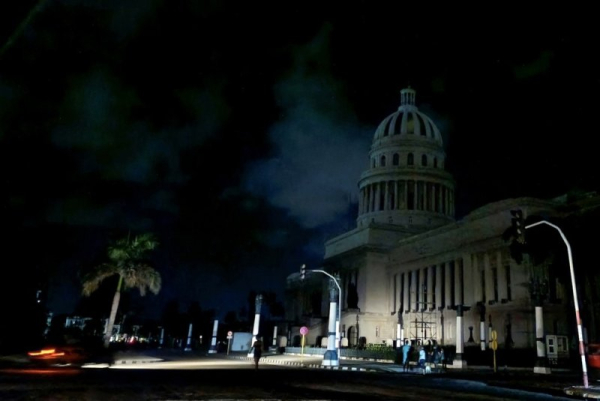
Cuba’s energy minister said Wednesda that Havana, the capital, was without electricity for as much as 22 hours a day because the country had run out fuel. File photo by Ernesto Mastrascusa/EPA-EFE
Cuban Energy Minister Vincente de la O Levy said the country’s diesel and fuel oil stocks had run completely dry and that the energy system was on life support due to the oil embargo imposed by the United States in January.
“We have absolutely no diesel,” O Levy said in an interview broadcast on state-run national television Wednesday night in which he repeatedly stated that oil stocks to generate power for the electrical grid were pretty much exhausted too.
O Levy said that a lone delivery of 730,000 barrels of oil gifted by Russia in March had run out and the national grid was now completely dependent on Cuba’s home-produced crude oil, natural gas and renewable energy.
“In Havana, the blackouts now exceed 20-22 hours [per day]. The situation is very tense, it’s becoming hotter,” he said, referring to surging demand for energy with the arrival of summer on the island.
In a post on X on Wednesday evening, Cuban President Miguel Diaz-Canel blamed a 2,000 megawatt electricity shortfall overnight and 1,100 megawatts that could have been produced during the day had the fuel to generate it been available to power stations on a “criminal siege.”
“This dramatic worsening has a single cause: the genocidal energy blockade to which the United States subjects our country, threatening irrational tariffs against any nation that supplies us with fuel,” Diaz-Canel wrote.
The comments came as Havana and Washington traded claim and counterclaim over purported behind-the-scenes U.S. offers to provide $100 million in assistance that the Cuban government claimed it was unaware of, with the State Department formally reiterating Wednesday that its offer was still on the table.
In a news release, the State Department said Cuba had rebuffed repeated private offers of financial assistance made by the United States, including support for free and fast satellite internet.
“The regime refuses to allow the United States to provide this assistance to the Cuban people, who are in desperate need of assistance due to the failures of Cuba’s corrupt regime. Today, the Department of State is publicly restating the United States’ generous offer to provide an additional $100 million in direct humanitarian assistance to the Cuban people that would be distributed in coordination with the Catholic Church and other reliable independent humanitarian organizations,” the news release said.
The State Department added that the decision lay with the Cuban government to either accept the offer or be accountable to the people of Cuba for blocking them from receiving “critical living-saving aid.”
On Tuesday, Cuban Foreign Minister Bruno Rodríguez Parrilla denied any knowledge of the offer of assistance, calling it a “fable” and a “$100 million lie.”
“Someone should ask the U.S. secretary of state about the fable of the alleged offer of $100 million in humanitarian aid to Cuba, which nobody here knows anything about,” Rodríguez said.
He questioned the source of the funds for the aid, the means of distribution, and if it would be in cash or goods.
“It would be good to know who specifically would contribute the money, whether it would be delivered in cash for fundamental needs, like fuels, food, and medicines, or whether it would be a material delivery and of what and from which company or agency the products would be purchased,” Rodriguez said.
He also cast doubt on the intent, arguing that lifting the oil embargo was an easier way to help.
“Will it be a donation, a deception or a dirty business to undermine our independence,” said Rodriguez.
U.S. President Donald Trump resumed ramping up a six-decade-old American ecomonic embargo on Cuba in January after cutting off its main supply of oil from Venezuela and threatening sanctions on Mexico, its second largest supply, and any other country that provided oil to the island.
A Jan. 29 executive order issued by Trump declaring the Cuba situation a national emergency said “the policies, practices, and actions of the Government of Cuba constitute an unusual and extraordinary threat to the national security and foreign policy of the United States.”
On May 7, the State Department sanctioned Moa Nickel S.A., Grupo de Administracion Emresarial S.A., and GAESA senior executive officer Ania Guillermina Lastres Morera, saying they were being held accountable for helping the regime ruin Cuba.
It alleged that proceeds from GAESA, a state organ controlling about 40% of Cuba’s economy, were being “funneled away to hidden overseas bank accounts” instead of being invested to solve the hunger, poverty and improve the failing power grid and other critical infrastructure.
The State Department said MNSA had “exploited Cuba’s national resources to benefit the regime” and profited from assets belonging to U.S. citizens and companies seized by the Cuban regime in the past.
Historic May moments through the years
Wreathes are seen amongst the statues at the Korean War Veterans Memorial during Memorial Day weekend in Washington on May 27, 2023. Memorial Day, which honors U.S. military personnel who died while in service, is held on the last Monday of May. Photo by Bonnie Cash/UPI | License Photo
