


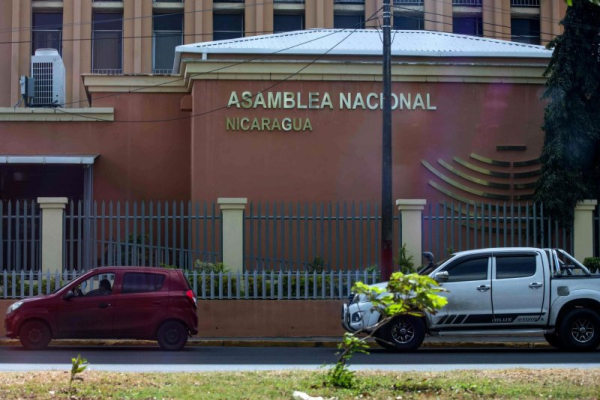
A magnitude 5.8 earthquake rattled the Dominican Republic on Friday. Hours after, another 5.2 earthquake struck western Nicaragua, capping a week marked by intense seismic activity across several countries. File Photo by Stringer/EPA
A magnitude 5.8 earthquake rattled the Dominican Republic on Friday. Hours after, another 5.2 earthquake struck western Nicaragua, capping a week marked by intense seismic activity across several countries that left hundreds dead in Venezuela and triggered strong earthquakes across Asia and North America.
A magnitude 5.8 earthquake struck about 102 kilometers north-northeast of Punta Cana in the Dominican Republic, according to the U.S. Geological Survey.
The tremor was felt across parts of the Dominican Republic and Puerto Rico, around 2 a.m. this Friday, prompting precautionary evacuations from some public and private buildings, although authorities reported no significant damage or casualties and said there was no tsunami threat.
Officials also urged residents to remain alert for possible aftershocks.
Throughout the morning and into midday, additional tremors measuring up to magnitude 5.0 were recorded at a depth of 71.3 kilometers southeast of La Romana.
According to the Colombian Geological Service, the Nicaraguan earthquake struck at 6:57 a.m. local time, with its epicenter in the municipality of Villa El Carmen at a depth of 120 kilometers.
The quake was felt as a light tremor in Managua and nearby communities, although no casualties or significant structural damage had been reported.
#SismosColombiaSGC Evento Sísmico Internacional – Boletín Actualizado 1, 2026-06-26, 06:57 hora local. Magnitud 5.2, Profundidad 120 km, Villa El Carmen, Nicaragua #NoticiaEnDesarrollo #Temblor #Sismo Más información: https://t.co/63pt8nVsSe pic.twitter.com/GuFsKhSP0E— Servicio Geológico Colombiano (@sgcol) June 26, 2026
According to the Colombian Geological Service, the event was also recorded by several international seismic networks, which located the epicenter in western Nicaragua, an area of frequent seismic activity caused by the subduction of the Cocos Plate beneath the Caribbean Plate.
The country’s high seismic activity is also linked to its geological characteristics.
Managua sits atop a complex system of between 16 and 20 active geological faults, whose interaction with tectonic plate movement makes the Nicaraguan capital one of the cities at greatest seismic risk in Central America.
The earthquake followed several powerful earthquakes recorded around the world in recent days.
The most severe emergency is unfolding in Venezuela, where an unusual double earthquake measuring 7.2 and 7.5 struck the country on Wednesday.
According to the latest official toll released by Executive Vice President Delcy Rodríguez, the disaster has left 589 people dead and more than 2,980 injured, while search and rescue operations continue with support from international teams.
Rodríguez also said Friday that 214 aftershocks have been recorded across different parts of the country since the June 24 earthquakes.
The latest tremor measured magnitude 4.4 and temporarily forced rescuers and volunteers working in the rubble to evacuate.
The U.S. Geological Survey had previously warned of a high probability of additional aftershocks during the seven days following the main earthquake.
Explaining Venezuela’s unusual double earthquake, seismologist and volcanologist Hugo Yepes told NotiMundo that the phenomenon was caused by the tectonic configuration of northern South America.
According to Yepes, the release of accumulated energy along the Boconó Fault, which crosses the Venezuelan Andes and extends from Ecuador, may have triggered the second earthquake along the San Sebastián Fault.
“It released energy and was the straw that broke the camel’s back for the second fault and the second earthquake,” he said.
Civil engineer and seismologist Gina Terremoto, meanwhile, said the earthquakes recorded in Venezuela are not part of the Pacific Ring of Fire but instead result from the natural interaction between the South American and Caribbean plates.
Hilo con aclaraciones. A combatir la desinformación.
1. Los sismos que ocurrieron en Venezuela no forman parte de la actividad del cinturón de fuego del PACÍFICO. Porque no quedan en el PACÍFICO ni hacen parte de su dinámica tectónica.
+ pic.twitter.com/itJ931qiKO— Gina Terremoto (@ginaterremoto) June 26, 2026
The specialist also warned that the hundreds of aftershocks recorded since Wednesday are part of the normal ground readjustment process and could continue for weeks or even months.
The scale of the Venezuelan event was also reflected in the propagation of its seismic waves.
According to the Geociències Barcelona scientific network, seismic waves generated by the Venezuelan earthquakes were detected by seismographic stations in Catalonia just over 10 minutes after the earthquakes, having traveled more than 7,500 kilometers from the epicenter.
Physicist and seismography expert Jordi Díaz Cusí shared the records obtained by the scientific network.
Les ondes sismiques generades pels terratrèmols de Venazuela (mag 7.2-7.5) i de Japó, enregistrats als sismòmetres de la xarxa sismica educativa del @GEO3BCN_CSIC @raspishake pic.twitter.com/ovbH7lCPtj— Jordi Diaz Cusi (@JDiazCusi) June 25, 2026
This week’s seismic activity also included a magnitude 6.5 earthquake in the Philippines, which prompted monitoring protocols across parts of the archipelago; a magnitude 6.9 earthquake off Japan’s Iwate Prefecture; a magnitude 5.6 earthquake in Northern California; a magnitude 5.2 earthquake in China’s Qinghai province; and a magnitude 4.9 earthquake in Peru’s Ucayali region.
Nicaragua, Japan, the Philippines and much of the western coast of the Americas lie along the Pacific Ring of Fire, a tectonic belt stretching approximately 40,000 kilometers that accounts for about 90% of the world’s seismic activity and roughly 75% of its active volcanoes.
