

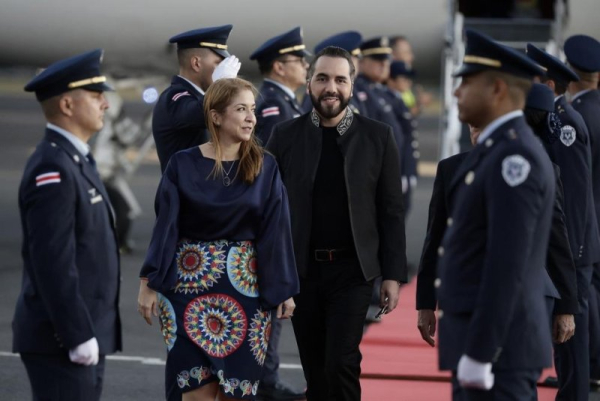
The president of El Salvador, Nayib Bukele (R), walks alongside the vice president of Costa Rica, Mary Munive, at Juan Santamaria airport in San Jose, Costa Rica, on Tuesday. Bukele on an official visit during which he was to lay the cornerstone of a high security prison modeled after a facility built in El Salvador to combat gangs. The trip that has drawn controversy for coinciding with the Costa Rican election campaign. Photo by Jeffrey Arguedas/EPA
El Salvadorian President Nayib Bukele traveled to Costa Rica during the final stretch of that country’s presidential campaign, triggering a fresh political and legal controversy.
Bukele’s main public activity was attending a midday ceremony Wednesday to mark the start of construction of the Center for High Containment of Organized Crime, known by its Spanish acronym CACCO, a new maximum security prison promoted by the Costa Rican government.
The facility is a smaller version of El Salvador’s Terrorism Confinement Center, or CECOT, built under Bukele’s administration to hold members of criminal organizations.
The Salvadoran government donated the prison blueprints to Costa Rica, a contribution that President Rodrigo Chaves’ administration says saved an estimated $25 million, according to Costa Rican outlet El Observador.
CECOT, which holds gang members and people accused of terrorism, has become a symbol of El Salvador’s crackdown on organized crime. U.S. President Donald Trump’s administration also deported migrants there who were identified as suspected gang members.
Confirmation that Bukele would arrive in Costa Rica just three weeks before the presidential election opened a new front of conflict between Chaves’ government and the opposition. Costa Rica votes Feb. 1, and public security has dominated the campaign debate.
In that context, Bukele’s figure, widely associated in Central America with hardline security policies, is seen by supporters as proof that order can be restored. Critics point to his consolidation of power and what they describe as the erosion of democratic institutions in El Salvador.
The visit also prompted legal action before Costa Rica’s Supreme Electoral Tribunal, known as the TSE, the independent body that oversees elections.
Semanario Universidad reported that the TSE received complaints tied to Bukele’s arrival, including requests to bar his entry over concerns of electoral interference and cross-complaints among political actors alleging foreign financing and political use of the visit.
The tribunal rejected those challenges and decided the visit could proceed, while warning that foreign delegations must not intervene in domestic political affairs, La Nacion reported.
That decision, though, became a political event, turning a protocol visit into an episode with clear electoral implications, where any gesture, statement or photograph could be read as endorsement or interference.
Opposition presidential candidate Claudia Dobles questioned the visit.
“The first thing is that President Bukele comes for nothing,” she said, calling it “an inspection of a prison that does not exist.”
“They sold us smoke with the idea of a mega-prison because in reality it is an expansion of La Reforma,” she said, referring to Costa Rica’s main prison complex, “which does need to be done,” Dobles told outlet CRHoy.
Costa Rica is facing a surge in violence linked to organized crime and drug trafficking disputes that has pushed homicides to historic highs.
The country recorded 873 in 2025, nearly matching the 876 reported in 2024 and following a record 906 killings in 2023, according to data from the Judicial Investigation Agency, known as the OIJ, Costa Rica’s main criminal investigation body.
Official analyses show that many of the killings are attributed to score-settling and were committed primarily with firearms, a pattern consistent with the expansion of criminal networks and their territorial control.
