

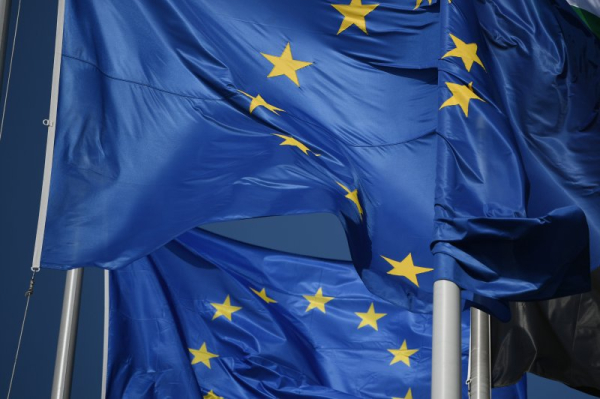
Embracing a “two-speed EU” and “buying European” were among issues being discussed Thursday at a summit of European leaders as they grapple with how to revive the bloc’s ecoonomy and stave off competiton from China and the United States. File photo by Patrick Seeger/EPA-EFE
Leaders of 27 European Union countries were holed up in a 16th-century castle on the Belgian-Netherlands border Thursday for an emergency brainstorming session on ways to boost the bloc’s weak economy, slash red tape and compete with the United States and China for investment.
Prospects for a breakthrough were not high due to major differences over how far and fast to proceed, with French President Emmanuel Macron and German Chancellor Friedrich Merz pushing for the EU to step on the gas to catch up with rivals that are forging ahead.
Former European Central Bank president and Financial Stability Board chair Mario Draghi pitched a compromise solution to leaders that calls for greater use of enhanced cooperation, where states that are willing to make the changes necessary “move faster” with countries that disagree being allowed to carry on as they were and exempted from the costs.
An official at the summit at Alden Biesen castle said Draghi had told leaders they should consider the benefits of the mechanism, a legal provision protected under the Lisbon Treaty, to speed up progress in tackling the most critical issues needed to turn around the economy.
Ahead of Thursday’s meeting, Draghi, who was Italian prime minister from 2021 through 2022, called for “pragmatic federalism.”
His comments came three days after European President Ursula von der Leyen made a similar pitch in a letter to leaders.
“Our ambition should always be to reach an agreement among all 27 member states. However, where a lack of progress or ambition risks undermining Europe’s competitiveness or capacity to act, we should not shy away from using the possibilities foreseen in the treaties under enhanced cooperation,” von der Leyen wrote.
Nevertheless, Draghi and von der Leyen’s suggestions are radical because they represent a break with the historical consensus within the bloc, where nothing can happen without the agreement of all member states, signalling that a two-speed European Union is possible or even desirable.
Brussels has already drawn upon enhanced cooperation, most recently in December, when it was used to get through approval of a plan to loan $105 billion to Ukraine in the face of opposition from several EU countries. Hungary, Slovakia and the Czech Republic were able to negotiate exemptions from contributing in exchange for not vetoing the loan.
Division was also expected to rear its head at the meeting over how much EU countries should “Buy European” to support the bloc’s economy, with Macron and Merz disagreeing on a proposed Industrial Accelerator Act mandating targets for the percentage of European-made content in products from solar panels to EVs.
Macron said earlier this week that buying European was necessary across strategically key industries, including clean tech and defense, to protect Europeans “swept aside.”
However, Merz warned that regulation mandating goods made in Europe might prove too restrictive, saying he would prefer to see a mechanism that extended to the EU’s closest trading partners.
Belgian Prime Minister Bart De Wever warned that declines in the manufacturing industry and investment, caused by high energy costs, burdensome regulation and “dumping” of heavily-subsidized Chinese goods that were pouring into Europe, presented an “existential risk” for his country, along with France, Germany and the Netherlands.
“We all know we must change course. Yet, it sometimes feels as if we are still standing on the bridge of the ship, staring at the horizon, without touching the helm,” said De Wever.
