

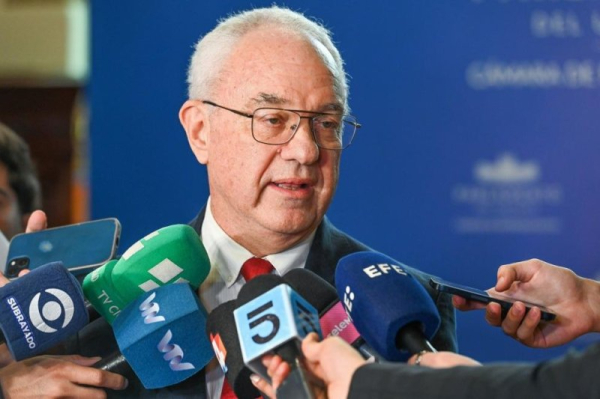
Uruguayan Foreign Minister Mario Lubetkin speaks to the media in Montevideo, Uruguay, on Thursday after Uruguay became the first country to complete the domestic ratification process for the EU-Mercosur trade agreement. Photo by Federico Gutierrez/EPA
The European Commission said Friday it will provisionally apply its trade agreement with Mercosur after Argentina and Uruguay completed their national ratification processes, advancing a long-delayed pact between the European Union and the South American bloc.
European Commission President Ursula von der Leyen announced the decision at a news conference, saying that after intense discussions with EU member states and lawmakers the institution will proceed with the immediate provisional application of the commercial portion of the agreement with the Southern Common Market, known by its Spanish acronym Mercosur.
The bloc includes Argentina, Brazil, Paraguay and Uruguay.
This legal step allows the commission to bypass blockage imposed in January by factions of the European far left and far right, which together with most French representatives, agreed to refer the pact to the European Court of Justice to determine whether it complies with EU treaties, Spanish newspaper El Mundo reported.
Under EU law, the application remains provisional until the European Parliament grants final approval, which could take 18 to 24 months because of the pending judicial review.
The legislatures of Uruguay and Argentina were the first in Mercosur to ratify the agreement Thursday.
Uruguay’s foreign minister, Mario Lubetkin, called the ratification “extraordinary” and paid tribute to those involved in the 25 years of negotiations, according to Infobae. He highlighted the “extraordinary weight” now borne by authorities responsible for implementing the commitments.
In Brazil, the lower house has approved the agreement and the Senate is expected to consider it in the coming days. Paraguay has submitted the text to its Congress for ratification.
“It is very good news because it shows the trust and enthusiasm of our partners to deepen our relationship and launch this historic agreement,” von der Leyen said about the ratifications by Uruguay and Argentina.
She added that the pact “opens countless opportunities, reduces billions in tariffs, and allows our small and medium-sized enterprises to access markets and scale they could previously only dream of.”
Von der Leyen described the accord as “one of the most important trade deals of the first half of this century” between “partners who understand that open, rules-based trade delivers positive results for all.”
The agreement will eliminate tariffs on more than 90% of trade between the two blocs, creating what officials describe as the world’s largest free trade area in terms of combined population and economic output.
European industries such as automobiles, textiles and machinery would gain improved market access in Mercosur countries, while South American agricultural and mineral exports are expected to benefit significantly.
Von der Leyen defended the “strategic” need for the move, a reference to what she described as an unstable geopolitical and trade environment shaped by President Donald Trump’s tariff policies, according to Spanish newspaper El País.
That instability has intensified in recent weeks amid uncertainty surrounding a tariff agreement signed last July between the European Union and the United States.
A recent U.S. Supreme Court ruling struck down tariffs imposed under an emergency powers law, raising questions about the legal basis for certain measures and prompting the European Parliament to delay its review of the EU-U.S. accord.
