


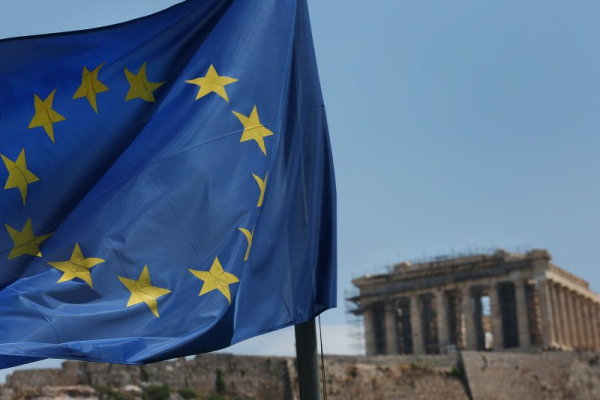
The European Parliament approved a resolution calling for the immediate suspension of political dialogue and cooperation agreements with Cuba. File Photo by Orestis Panagiotou/EPA
The European Parliament approved a resolution Thursday calling for the immediate suspension of political dialogue and cooperation agreements with Cuba unless the government moves toward a multiparty democracy and releases all political prisoners.
The measure passed with 283 votes in favor, 199 against and 85 abstentions. It also calls for targeted sanctions against Cuban leader Miguel Díaz-Canel and senior members of his administration.
In the resolution, lawmakers said that after more than five decades of communist rule, Cuba is at risk of becoming a failed state. They argued that the country’s humanitarian crisis, which they said has left 89% of families living in extreme poverty, is “not the result of any external embargo, but the direct consequence of the regime’s model and failures.”
The initiative responds to what lawmakers described as the continued deterioration of human rights conditions on the island and the systematic persecution of dissenting voices.
The resolution explicitly identifies officials it considers responsible for repression. Members of Parliament urged the Council of the European Union to apply the bloc’s Magnitsky-style sanctions regime to freeze assets and ban travel to Europe for key figures in the Cuban government.
In addition to Díaz-Canel, potential targets include senior officials from the Revolutionary Armed Forces, the Interior Ministry and executives of the military-run conglomerate GAESA, which controls some of Cuba’s most profitable sectors.
Judges and prosecutors involved in what the resolution describes as arbitrary convictions of peaceful protesters were also identified as possible candidates for sanctions.
One of the measures approved by Parliament calls for activating the human rights clause of the Political Dialogue and Cooperation Agreement, or PDCA, to immediately suspend the political and trade accord signed between the European Union and Cuba in 2016. Lawmakers argued that the Cuban government has flagrantly failed to uphold commitments to respect fundamental freedoms that formed part of the agreement.
The European Parliament said any future normalization of relations should be conditioned on three key requirements: the immediate and unconditional release of roughly 1,300 political prisoners, an end to the harassment of activists and the opening of genuine channels for a democratic multiparty transition.
To help alleviate humanitarian suffering without benefiting state institutions, lawmakers also urged the European Commission to explore alternative mechanisms for delivering aid directly to Cuban citizens. The proposal calls for assistance to be channeled through independent nongovernmental organizations, churches and civil society groups rather than institutions controlled by the Cuban state.
Although the resolution increases political pressure on the government in Havana, the authority to impose sanctions and suspend the bilateral agreement rests with the Council of the European Union, where unanimous approval by member states would be required.
