

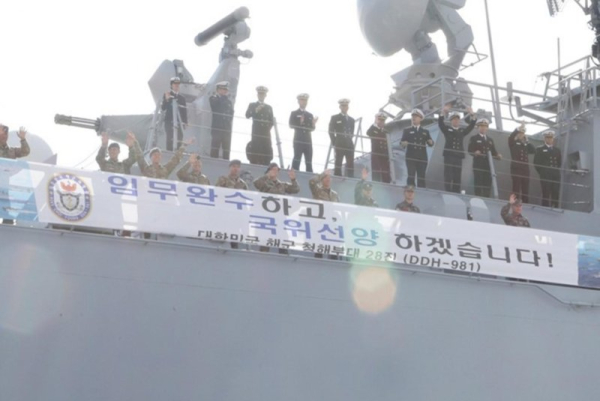
The 28th 300-strong Cheonghae Unit departs for the Gulf of Aden to combat piracy off Somalia aboard the 4,400-ton ship. Photo by YONHAP / EPA
Military experts say South Korea would need a layered anti-drone defense system if the Cheonghae Unit is deployed near the Strait of Hormuz, where Iranian and Iran-backed forces could pose a growing threat using low-cost attack drones.
The issue gained urgency after U.S. President Donald Trump publicly called on South Korea on Friday to send a warship to help ensure freedom of navigation in the strategic waterway.
Defense analysts say the more important question is not only whether South Korea would dispatch forces, but whether its military is prepared for the kind of drone warfare now seen in the Middle East and Ukraine.
In recent conflicts, low-cost one-way attack drones have emerged as a major threat. Experts say Iran’s Shahed-136 drone, in particular, has demonstrated how relatively inexpensive systems can overwhelm traditional air defenses when launched in large numbers.
Analysts describe the imbalance as a cost problem in modern air defense. A drone costing tens of thousands of dollars can force a defender to use interceptors worth far more, raising questions about the long-term sustainability of missile-based defenses alone.
Experts say that if the Cheonghae Unit were sent to waters near Hormuz, it could face drone threats as part of Iran’s broader asymmetric maritime strategy, which has combined mines, fast attack craft and drones around the strait.
The consensus among defense specialists is that no single system would be sufficient. Instead, they recommend a layered defense that combines early detection, electronic warfare, low-cost interception and close-in protection.
The first requirement is better detection. Shahed-type drones often fly slowly and at low altitude, making them difficult for conventional radar to track. Analysts say shipborne radar would need improved low-speed target detection, supported by electro-optical and infrared sensors.
They also say intelligence sharing with U.S. Central Command and allied surveillance networks in the region would be a practical way to strengthen early warning.
Electronic warfare would form the second layer. Because Shahed drones rely on GPS and inertial navigation, experts say jamming and signal disruption could provide an effective and relatively low-cost countermeasure.
A third layer would involve cheaper interception tools. Analysts say relying on expensive missiles against mass drone attacks is not economically sustainable. They point instead to 30 mm guns, shipboard cannons and heavy machine guns as more practical options.
Some experts also highlight the growing role of interceptor drones – small drones designed to destroy hostile drones in flight – as an emerging and less costly defense option.
The final layer would be close-in defense systems already mounted on naval vessels, including the Phalanx Close-In Weapon System, or CIWS. Though originally designed to intercept anti-ship missiles, such systems can also engage slower unmanned aircraft under some conditions.
Analysts say the challenge for South Korea is that its air defense structure has traditionally focused on ballistic missiles and aircraft, not mass attacks by low-cost drones.
One military expert said drone warfare is ultimately a contest of economics, warning that a defense model built around costly interceptors may be exhausted first in a prolonged fight.
Experts say any debate over sending the Cheonghae Unit to Hormuz should also prompt a broader review of South Korea’s military preparedness against drones.
They argue that South Korea urgently needs a Korean-style anti-drone defense network that integrates electronic warfare, lower-cost interceptors and drone-on-drone defenses.
The Strait of Hormuz remains one of the world’s most strategically important chokepoints, carrying about one-fifth of global oil shipments while also posing some of the highest risks from mines, small boats and drones.
— Reported by Asia Today; translated by UPI
© Asia Today. Unauthorized reproduction or redistribution prohibited.
Original Korean report: https://www.asiatoday.co.kr/kn/view.php?key=20260316010004562
