

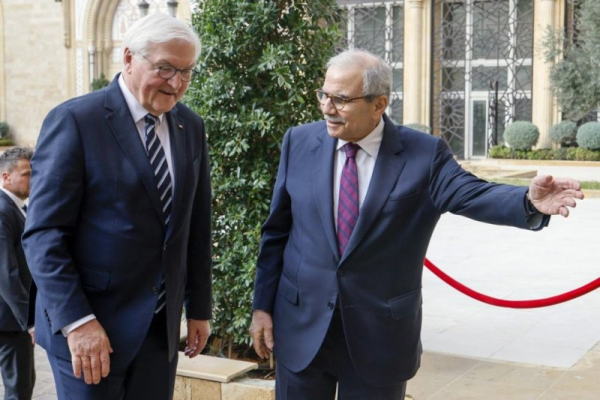
Lebanese Prime Minister Nawaf Salam (R) welcomes German President Frank-Walter Steinmeier at the Government Palace in Beirut, Lebanon, on Monday. Photo by Wael Hamzeh/EPA
German President Frank-Walter Steinmeier said Monday his country will continue to support Lebanon and its army to strengthen state authority, even after the U.N. peacekeeping force in south Lebanon completes its mandate in 2027 and German troops withdraw.
Steinmeier said after talks with Lebanese President Joseph Aoun that the end of the UNIFIL mission “does not mean the end of our support for Lebanon,” noting the importance of Lebanon being sovereign and stable, “for its own sake and for the stability of the region.”
He added, however, that Lebanon would need to make significant efforts to achieve that goal, emphasizing the need to strengthen the Lebanese armed forces, which have been tasked with disarming the Iran-backed Hezbollah after its recent conflict with Israel.
“The Lebanese armed forces are indeed the backbone of stability in Lebanon, and after the end of the UNIFIL mission, we must decide how to strengthen this backbone and lifeline,” Steinmeier said during a joint news conference with Aoun at the Presidential Palace.
Steinmeier said German naval forces are training the Lebanese navy and providing it with equipment, along with surveillance and monitoring capabilities, to help it strengthen its capacities after the UNIFIL mission ends.
Last August, the U.N. Security Council voted unanimously to terminate the U.N. Interim Force in Lebanon, or UNIFIL, which was established in March 1978 after Israel’s first invasion of southern Lebanon to maintain peace and stability in the embattled region.
The United States, which had pushed for the multinational peacekeepers to end their mission within six months in line with the demands of close ally Israel, then agreed to a 16-month extension to last until the end of December. After that, UNIFIL will begin a “safe and orderly” withdrawal, to be completed within one year.
The force grew significantly in size and scope after the 2006 Israel-Hezbollah war, counting 10,500 peacekeepers from 47 to 50 troop-contributing countries. As of this month, UNIFIL’s force consists of 7,538 peacekeepers from 48 troop-contributing countries, with Germany maintaining a contingent of 179 soldiers.
Aoun, whose country had expressed concerns over the vacuum UNIFIL’s departure could create, said that the presence of German forces alongside other European forces in southern Lebanon, after the peacekeeping force completes its mandate, would help strengthen security in the region.
He noted that consultations would be held with European countries that wish to retain part of their forces in the south to establish an appropriate framework for doing so.
Steinmeier said the Nov. 27, 2024, cease-fire agreement, brokered by the United States and France to end the war between Hezbollah and Israel — which began on Nov. 8, 2023, when Hezbollah opened a support front for Gaza — was “an opportunity” to achieve stability in the region.
He said his visit to Beirut was intended to ask both sides to commit to the agreement, emphasizing that Hezbollah must be disarmed to meet the other conditions for the withdrawal of Israeli forces from the areas they still occupy in southern Lebanon.
“We recognize that this issue is very difficult and serious,” he added, reiterating Germany’s rejection of “a permanent occupation of Lebanese territory,” which he described as “unacceptable and must end.”
“We do not say this only in Lebanon, but also in Israel,” Steinmeier said.
Aoun said he asked the German president to pressure Israel to respect the cease-fire accord and withdraw from five strategic points it still occupies.
He said Israel’s refusal to completely withdraw from southern Lebanon has so far prevented the full deployment of the Lebanese Army up to the borders. Last month, the army announced it had completed the first phase of its plan to disarm Hezbollah in the southern region, covering the area south of the Litani River.
The Lebanese president also confirmed that his country will proceed with implementing its decision regarding “the exclusive control of arms,” saying that the Lebanese “can no longer bear anyone’s conflicts or burdens.”
“Peace is not achieved by insisting on absolute conditions, but by letting them go. Today, we stand with you for absolute peace, rejecting any conditions for it except justice and goodness,” Aoun said.
Steinmeier also held talks with House Speaker Nabih Berri and Prime Minister Nawaf Salam that focused on the post-UNIFIL phase and the government’s efforts to disarm Hezbollah and adopt required financial reforms.
Meanwhile, Hezbollah Secretary-General Sheikh Naim Qassem said Monday that focusing on disarmament is “a grave sin” and serves the goals of the Israeli aggression.
“We do not want war, but we will not surrender and are ready to defend ourselves. … We can hurt them,” Qassem said, warning against underestimating their defensive capabilities “when the time comes.”
Since the 2024 cease-fire, Israel has operated with near-total freedom in Lebanon, continuing strikes on alleged Hezbollah sites and arms depots and killing suspected Hezbollah operatives.
It also refused to withdraw from five strategic positions in south Lebanon or release Lebanese prisoners and blocked displaced prisoners from returning to their largely destroyed villages.
Hezbollah, which was severely weakened during the war, has kept a low profile and refrained from retaliating while the Lebanese Army took control of the area south of the Litani River.
As it quietly attempts to reorganize its ranks and secure new channels for rearming and funding, Hezbollah has refused to fully disarm as long as Israel does not abide by the truce accord.
