

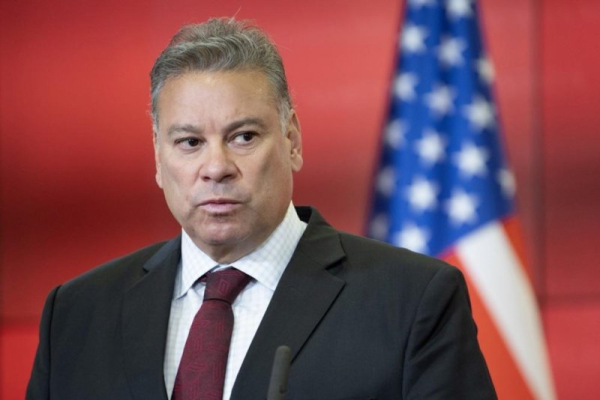
Goiás Gov. Ronaldo Caiado and U.S. Chargé d’Affaires Gabriel Escobar (shown) signed the mining agreement Wednesday at the U.S. Embassy in Brazil File Photo by Georgi Licovski/EPA
The United States signed a landmark memorandum of understanding with the Brazilian state of Goiás to explore and process critical minerals and rare earth elements.
This marks the first time Washington has reached a direct mining agreement with a subnational government without waiting for federal approval in that nation.
Goiás Gov. Ronaldo Caiado and U.S. Chargé d’Affaires Gabriel Escobar signed the agreement Wednesday at the U.S. Embassy in Brazil
Goiás has emerged as a strategic hub in the effort to diversify global supply chains. The state holds reserves of lithium and niobium and is home to the Serra Verde project, currently Brazil’s only commercial rare earth operation. The project has received financial backing from the U.S. International Development Finance Corp.
The deal positions Goiás as a key partner in U.S. efforts to secure supplies of critical minerals outside China, particularly in segments where global dependence remains high.
The decision to negotiate directly with Goiás, followed by a similar agreement expected with the state of Minas Gerais for lithium, comes amid cooler relations between the White House and President Luiz Inacio Lula da Silva’s administration.
Tensions have grown over diplomatic frictions and Brazil’s insistence on maintaining economic ties with partners such as China, India and South Korea.
By working directly with governors, U.S. officials gain faster access to geological data, local tax incentives and streamlined environmental licensing.
Brazil’s National Mining Agency retains final authority over exploitation permits, but state-level agreements can accelerate the entry of U.S. technology and capital into the sector, The Rio Times reported.
A central component of the pact is local processing. For decades, Brazil has exported raw materials. The U.S.-Goiás agreement seeks to establish facilities within the state to separate and refine rare earth elements.
The goal is to enable Brazil to export higher value components rather than unprocessed ore, while providing the United States with refined materials ready for industrial use, Caiado said.
For Goiás, the deal promises an influx of capital and specialized technology. For the United States, it strengthens supply chain reliability in sectors including electric vehicles, defense and advanced technologies.
Escobar said Washington is also in talks with Brazil’s federal government on a broader critical minerals supply chain agreement.
“We have a proposal at the federal level. We are discussing it, we have had preliminary conversations, but we are still waiting,” Escobar said, according to specialized outlet Mining.
Brazil holds the world’s second-largest rare earth reserves at about 21 million metric tons. It supplies more than 90% of global niobium and is the leading external source of alumina for the United States.
China controls about 60% of global rare earth extraction and nearly 90% of refining capacity, according to international reports.
