


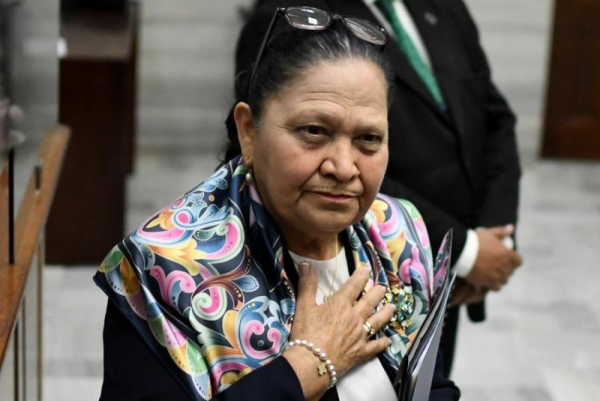
Guatemalan Attorney General Consuelo Porras arrives April 9 at the Nominating Commission in Guatemala City, Guatemala, for an interview as part of the selection process for attorney general and head of the Public Prosecutor’s Office from 2026 to 2030. She lacked support for another term. Photo by Alex Cruz/EPA
Consuelo Porras, Guatemala’s attorney general, will leave office May 17 after years of confrontation with President Bernardo Arévalo.
Porras is ending an eight-year term that began in 2018 under sanctions imposed by the United States, the European Union and more than 40 countries that accused her of corruption and undermining democracy by attempting to interfere with the results of Guatemala’s 2023 presidential election.
The relationship between Porras and Arévalo was marked by open confrontation and institutional hostility since the president’s electoral victory in 2023.
Arévalo repeatedly accused Porras of leading an “attempted coup” through judicial investigations aimed at dismantling Semilla, the political party that brought him to power, and blocking his inauguration. Porras defended her actions as enforcement of the law.
After taking office, Arévalo sought to remove her through legal reforms and public meetings that she refused to attend, deepening a political crisis in which the executive branch and the Public Ministry operated as opposing forces until the end of her tenure.
Arévalo announced Tuesday that he had officially appointed attorney Gabriel García Luna to lead the Public Ministry for the 2026-2030 term.
Este es un momento de grandes decisiones.
Que este sea el inicio de una nueva etapa de justicia. El pueblo lo exige y lo merece. pic.twitter.com/OuZK5FpAMt— Bernardo Arévalo (@BArevalodeLeon) May 6, 2026
While announcing the appointment, Arévalo said the decision was intended to mark the beginning of a “new stage of justice” in response to demands from the Guatemalan people.
The president said the Public Ministry requires leadership capable of “rescuing” the institution and strengthening its independence. He added that the new attorney general would not serve the interests of the government or “particular or spurious political interests,” but instead guarantee impartial justice.
According to reports by Guatemalan newspaper Prensa Libre and Argentine outlet Infobae, Arévalo justified his choice by saying the country needs officials capable of rebuilding judicial institutions after years of crisis.
Porras attempted to seek a third term, but failed to secure enough votes from the nominating commission to reach the final shortlist of six candidates presented to the president.
Before leaving office, she also unsuccessfully sought a seat on Guatemala’s Constitutional Court, a position that would have granted her immunity from possible future legal proceedings.
Among the most serious allegations she could face is a criminal complaint related to her alleged connection to a network of illegal adoptions of Indigenous children during the 1980s. United Nations experts have already called for independent investigations into the case.
Civil society organizations have also documented at least 16 alleged cases involving misuse of the criminal justice system, including political persecution against the Semilla party, journalists and judicial officials.
Although Guatemala’s current Supreme Court blocked several attempts to strip Porras of immunity while she remained in office, her departure could allow the next attorney general to reopen those complaints and launch additional investigations into alleged obstruction of justice and corruption during her administration.
U.S. sanctions mainly involved the revocation of her visa and a permanent ban on entering the country for both her and her husband after she was designated a “corrupt and anti-democratic actor” under the Engel List.
The U.S. Engel List is a State Department-mandated public sanctions list that names foreign individuals from Guatemala, El Salvador, Honduras, and, since 2021, Nicaragua whom the United States determined engaged in significant corruption, undermined democratic institutions or obstructed corruption investigations. Those on the list are barred from entering the United States and have their visas revoked.
That designation later served as the basis for the European Union and Canada to impose harsher sanctions, including the freezing of assets and bank accounts in those jurisdictions, sharply restricting her financial freedom outside Guatemala.
