

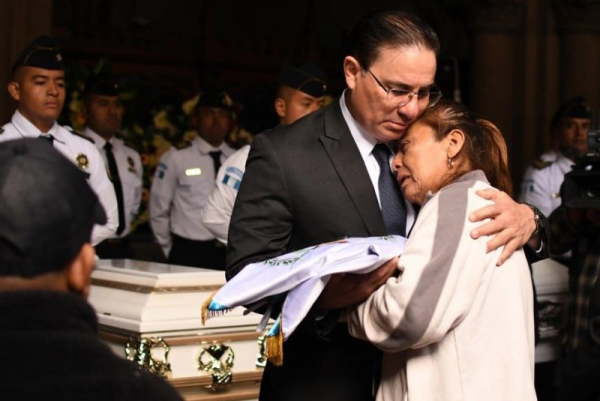
Guatemala’s minister of the interior, Marco Antonio Villeda presents a flag to the family member of a slain police officer at the Ministry of the Interior in Guatemala City, Guatemala, on Monday. Guatemala is under a state of siege decreed by the government of President Bernardo Arevalo de Leon after a wave of violence that shook the Central American country over the weekend with prison riots and the killingr of nine police officers by suspected gang members. Photo by Alex Cruz/EPA
Guatemala’s Congress approved a state of siege decreed by President Bernardo Arevalo in response to escalating gang violence and simultaneous riots at three prisons across the country.
The measure was ratified Monday during an extraordinary plenary session in which a broad majority of lawmakers backed the 30-day emergency order, according to the government-run Guatemalan News Agency.
Arevalo’s decision followed the killing of nine National Civil Police officers Sunday. The officers were attacked at different locations in Guatemala City in what authorities described as a coordinated assault allegedly carried out by gang members.
The executive branch said ordinary security measures were no longer sufficient to contain what it described as a serious threat to public order, prompting the activation of the exceptional legal framework.
The government linked the violence mainly to gangs such as Barrio 18, which authorities say sought to demonstrate their ability to act simultaneously inside and outside detention centers in retaliation for state security operations, local daily Prensa Libre reported.
Officials say these criminal structures continue to operate from within prisons and maintain active networks of extortion and contract killings.
During the second half of 2025, Barrio 18 and Mara Salvatrucha gangs maintained a fierce confrontation with the Guatemalan government over control of the prison system after their leaders were transferred on July 31 to a maximum-security prison to isolate them, according to daily La Hora. The move triggered repeated riots in penitentiary centers since then.
Under Guatemala’s constitution, a state of siege allows the temporary restriction of certain rights, including freedom of movement, freedom of assembly and the carrying of weapons.
It also authorizes security forces to carry out detentions without a judicial warrant in specific cases, under supervision of the Public Prosecutor’s Office, and permits the Army to support internal security operations.
During the legislative debate, lawmakers from different political blocs said the measure was necessary to regain control of the prison system and ensure public safety. Some legislators warned that its implementation must be closely monitored to prevent abuses and safeguard human rights.
Arevalo said the state of siege is not intended to criminalize the population, but rather to dismantle criminal structures that have responded with direct violence to the state’s efforts to reassert control over prisons and weaken the power of gangs.
In a post on X, Arevalo also accused the Public Prosecutor’s Office, with which he has a long-running dispute, of shielding those responsible for killing the police officers.
“Today, instead of rigorously pursuing those who cowardly murdered officers of the National Civil Police, the Public Prosecutor’s Office chose to protect them, asking only that they be charged with weapons and drug possession, while ignoring the serious crimes linked to their terrorist acts that would allow them to be prosecuted under the new anti-gang law, he wrote.
“This is an insult to the murdered police officers, their families and the people of Guatemala.”
