

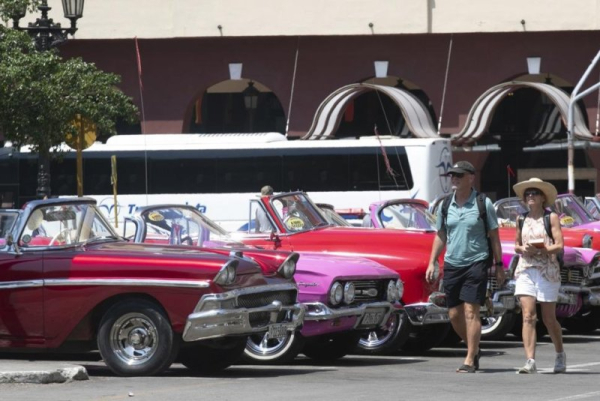
Tourists walk in front of classic cars in Havana, Cuba, in March 2024. Tourism has fallen off sharply, putting severe pressure on the country’s economy. File Photo by Yander Zamora/EPA
Cuba’s tourism sector has fallen to historic lows at a time when the island most needs foreign currency, intensifying pressure on an economy already in severe distress.
International tourist arrivals dropped to 1.8 million in 2025, down 17.8% from 2024, according to official figures from Cuba’s National Office of Statistics and Information. The result fell well short of the government’s target of 2.6 million visitors.
The figure marks one of the lowest levels in more than two decades, excluding the pandemic years, and remains far below the peaks recorded in 2018, when arrivals reached 4.6 million, and in 2019, with 4.2 million.
The collapse has had a direct impact on an economy that depends heavily on tourism as its main source of hard currency.
In 2025, Cuba faced an acute shortage of foreign visitors amid prolonged power outages and widespread shortages of fuel, medicines and food. The economic crisis, considered the worst in decades, has eroded domestic conditions and damaged the country’s image as a safe and functional destination, Infobae reported.
Official data show a broad contraction across Cuba’s main source markets. Travel by Cubans living abroad, mostly from the United States, fell 22.6%. Arrivals from Germany dropped 50.5%, from Russia 29% and from Canada 12.4%.
The deterioration of the tourism sector has also unfolded amid worsening energy tensions. The interruption of Venezuelan oil supplies after the capture of President Nicolás Maduro deprived the island of its main crude supplier and deepened shortages of fuel, electricity generation and basic services — factors that directly affect tourism activity.
Without fuel, public transportation, tourist buses and the classic cars that once carried visitors along Havana’s seaside boulevard have been sharply curtailed or have stopped operating, America Noticias reported.
Sanctions promoted by the Trumo administration added further pressure. Washington announced its intention to fully halt Venezuelan oil shipments to Cuba, asked Mexico to stop sending crude to the island and threatened tariffs on third countries that supply fuel to Havana.
At the same time, several governments updated travel advisories due to deteriorating conditions on the island. Argentina went further and recommended avoiding travel to Cuba.
The Cuban government has responded with public messages aimed at easing tensions.
In a statement issued by the Foreign Ministry and published by the state-run daily Granma, Cuba reaffirmed its willingness to cooperate with the United States on security, counterterrorism, money laundering and other transnational crimes — an unusual signal that might have resulted from the collapse of tourism and energy supplies, Reportur said.
President Miguel Díaz-Canel has said he is open to negotiations with Washington, though he stressed that “dialogue cannot take place under pressure.” Vice Foreign Minister Carlos Fernández de Cossío has acknowledged that messages have been exchanged between the two governments, but said there is no formal dialogue underway.
