

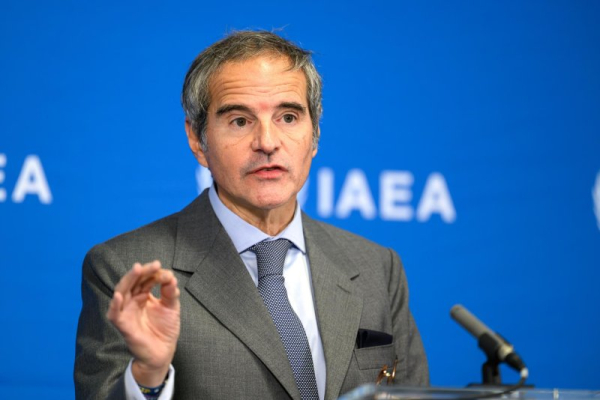
Director General of the International Atomic Energy Agency Rafael Grossi warned Monday that North Korea is continuing its uranium enrichment program. He made the remarks during an IAEA Board of Governors meeting in Vienna, Austria. Photo by Max Slovencik/EPA
The head of the International Atomic Energy Agency warned that North Korea continues operating uranium enrichment facilities and expanding key parts of its nuclear program, calling the developments a “serious concern.”
IAEA Director General Rafael Grossi delivered the assessment in his opening statement to the agency’s Board of Governors Monday at its headquarters in Vienna, where member states are meeting through Friday.
“The IAEA continues to monitor the nuclear program of the DPRK,” Grossi said, using the country’s official acronym. “The ongoing operation of enrichment facilities at Kangson and Yongbyon is of serious concern.”
Kangson is located near Pyongyang, while Yongbyon — about 60 miles north of the capital — houses North Korea’s main nuclear complex.
Grossi said the agency is monitoring a new building at Yongbyon with “dimensions and infrastructure, including power supply and cooling capacity, similar to the Kangson enrichment facility.” The structure is “externally complete and internal fitting is likely underway,” he said, suggesting additional enrichment capacity.
The 5 MW(e) reactor at Yongbyon “likely continues to operate in its seventh irradiation cycle,” Grossi said. He added that the site’s radiochemical laboratory operated between January and September 2025, when fuel from the reactor’s sixth cycle was “likely reprocessed.”
There are also indications the Yongbyon light-water reactor continues to operate following a shutdown between August and November 2025, he said.
At the Punggye-ri nuclear test site, Grossi reported “no indications of significant changes,” but said the site “remains prepared to support a nuclear test.”
“The continuation and further development of the DPRK’s nuclear program are clear violations of relevant U.N. Security Council resolutions and are deeply regrettable,” he said, adding that the agency maintains “enhanced readiness” to verify North Korea’s nuclear activities if political conditions permit.
The findings come as North Korean leader Kim Jong Un last week reaffirmed plans to expand the country’s nuclear deterrent at the Ninth Congress of the ruling Workers’ Party.
Kim pledged to increase the regime’s stockpile of nuclear weapons and broaden delivery systems and operational capabilities. He added that there was “no reason” Pyongyang could not improve ties with Washington if the United States abandons what he called its “hostile policy.”
