


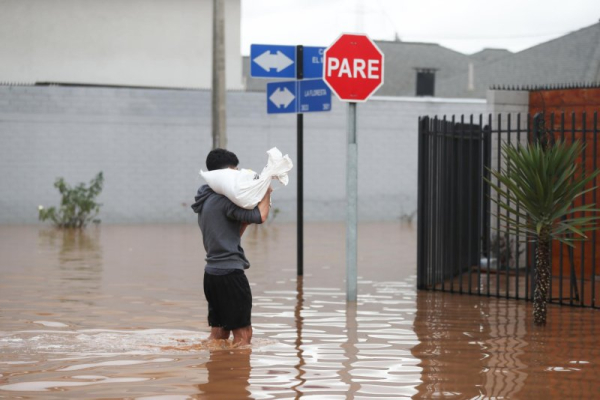
A person walks along a street flooded after the Bellavista Canal overflowed in the Mirador de la Hacienda neighborhood of La Serena, Chile, on Monday. President Jose Antonio Kast declared a state of constitutional exception of catastrophe for the Coquimbo Region and Huasco province in response to the damage caused by the frontal system. Photo by Hernan Contreras/EPA
A storm system associated with the El Niño phenomenon that affected much of Chile has left at least 13 people dead, four missing, nearly 65,000 people affected and economic losses estimated at more than $700 million, according to the latest official figures and an analysis by consulting firm Colliers.
Heavy rainfall, flooding, strong winds and snowfall affected 10 of the country’s 16 regions for more than five days. At the peak of the emergency, more than 658,128 people were left without electricity, according to the National Disaster Prevention and Response Service, the Chilean agency responsible for coordinating emergencies.
“What normally falls in a month came down in one hour,” Deputy Interior Minister Máximo Pavez told reporters, referring to the rainfall that hit the Coquimbo region.
In Santiago, meanwhile, 4.01 inches of rain fell over three days, more than the city’s average rainfall for the entire month of July, according to a study by consulting firm Unholster. It was the highest total since 2002 and one of the 10 most intense storms to hit the Chilean capital.
The storm system caused flooding, rivers to overflow, widespread disruptions to essential services and damage to nearly 29,000 homes, in one of the country’s most severe weather events in the past four decades.
One of the hardest-hit areas was the wine-producing Coquimbo region, where 3.1 inches of rain fell Sunday, the highest single-day rainfall recorded there since 1987.
“We are experiencing an unprecedented weather event in the region,” Pavez said.
A new assessment by consulting firm Colliers estimated the economic damage caused by the storm system at more than $700 million.
According to the consulting firm, more than $400 million corresponds to damage to public infrastructure, transportation networks, power grids and essential services, while another $200 million is associated with damage to homes.
“Although the damage caused by the storms is significant from a social and territorial standpoint, its macroeconomic impact on Chile still appears manageable. However, it does generate substantial costs for the state, affects thousands of families and businesses, and requires resources to be allocated to emergency response and reconstruction efforts,” Jaime Ugarte, executive director of Colliers, told UPI.
Ugarte said losses of this magnitude represent a relatively small share of the Chilean economy and therefore should not significantly alter the country’s growth outlook because the large-scale mining sector has not suffered major damage.
“Large-scale mining, which is the country’s main export generator and one of its largest sources of government revenue, has not experienced damage significant enough to compromise its structural operations,” he said.
In the agricultural sector, losses are estimated at about $75 million due to damage to crops, infrastructure, table grape vineyards and pisco grape vineyards in the country’s north.
However, Colliers said part of those losses could be offset over the medium term by greater water availability, the recovery of reservoirs and snow accumulation in the Andes, factors that would improve irrigation availability for upcoming agricultural seasons.
Despite the impact, authorities have so far ruled out widespread increases in fruit and vegetable prices.
“For the time being, there should not be significant price increases because supply is sufficient and distribution remains stable,” Antonio Walker, president of the National Agriculture Society, said.
The final cost of the emergency could continue to rise due to the arrival of another storm system expected Saturday, although it is forecast to be less intense than the previous one, according to projections from the European Centre for Medium-Range Weather Forecasts model.
“This new event would extend a series of storm systems that have already brought abundant rainfall during July. With soils becoming increasingly saturated, additional rainfall could still cause localized problems in some areas,” weather website Meteored said.
