


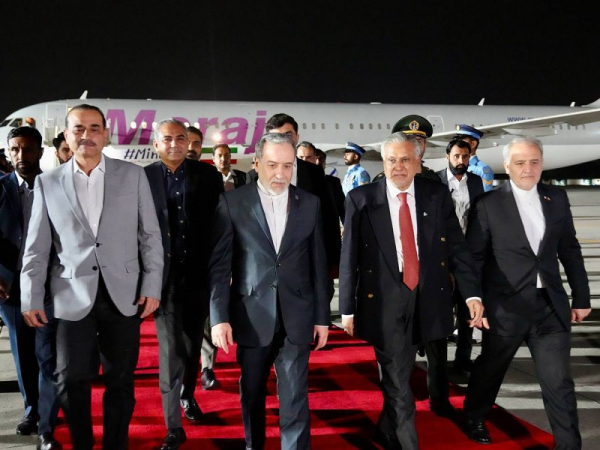
Iranian Foreign Minister Abbas Araghchi (2nd L) is welcomed by Pakistani Foreign Minister Muhammad Ishaq Dar (2nd R) in Islamabad, Pakistan on Friday. Araghchi made his second visit to Islamabad in 48 hours on Sunday, en route to Russia. Photo by Iranian Ministry of Foreign Affairs/UPI | License Photo
Iran’s foreign minister conveyed Tehran’s red lines to the United States through Pakistani mediators Sunday during a brief visit to Islamabad en route to Russia, where he is expected to meet with President Vladimir Putin.
It was Foreign Minister Seyed Abbas Araghchi’s second visit to Pakistan in 48 hours. He is on a three-country trip to Pakistan, Oman and Russia that began Friday amid stalled peace talks between the United States and Iran.
Araghchi arrived at Nur Khan Air Base on Sunday afternoon and was met by Pakistan’s Interior Minister Mohsin Naqvi and Iranian Ambassador to Islamabad Reza Amiri Moghadam, according to the state-run Islamic Republic News Agency.
During the brief visit, Araghchi transmitted written messages to the United States through Pakistan outlining “certain red lines of the Islamic Republic of Iran, including nuclear issues and the Strait of Hormuz,” the Islamic Revolutionary Guard Corps-linked Fars News Agency reported.
Few details of the messages were made public. Fars reported the messages “were not related” to U.S.-Iran negotiations but were intended “to clarify the regional situation and explicitly state the Islamic Republic’s red lines.”
Araghchi later announced on Telegram that he had departed Pakistan for Russia, where he is to meet with senior officials.
Kazem Jalali, Iran’s ambassador to Russia, said Sunday on social media that Araghchi will meet Putin in St. Petersburg on Monday, where they will discuss “coordinating interactions and advancing joint programs.”
“Iran and Russia are present in a united front in the campaign of the world’s totalitarian forces against independent and justice-seeking countries, as well as countries that seek a world free from unilateralism and Western domination,” he said.
The U.S.-Israel war against Iran has seen heightened diplomacy between Iran and Russia, with Moscow reportedly sharing military intelligence about Washington’s military assets with Tehran. Ukrainian President Volodymyr Zelensky earlier this month also accused Russia of sharing satellite intelligence on Israel’s energy system with Iran.
Araghchi’s trip comes as U.S.-Iran peace talks have stalled.
U.S. envoys Steve Witkoff and President Donald Trump’s son-in-law Jared Kushner were scheduled to conduct talks with Araghchi in Pakistan over the weekend until Trump called them off.
“We have all the cards. We’re not going to spend 15 hours in airplanes all the time going back and forth to be given a document that’s not good enough,” Trump told reporters before boarding Air Force One in Palm Beach, Fla.
“We’re not going to be traveling 15, 16 hours to have a meeting with people that nobody ever heard of.”
He said Iran had made them an offer that “should have been better.” After canceling the talks, Iran sent over a “much better” document.
“They offered a lot but not enough,” he added.
Iran never confirmed the talks.
On Tuesday, Iranian Ambassador to the United Nations Amir-Saeid Iravani told reporters at the organization’s headquarters in New York that the next round of negotiations would be held after the Trump administration ends its blockade of Iran’s ports.
A Sunday report from the Washington-based Institute for the Study of War said prospects of meaningful U.S.-Iran talks “remain low,” stating the IRGC is in control of decisions in Iran and opposes compromise.
