

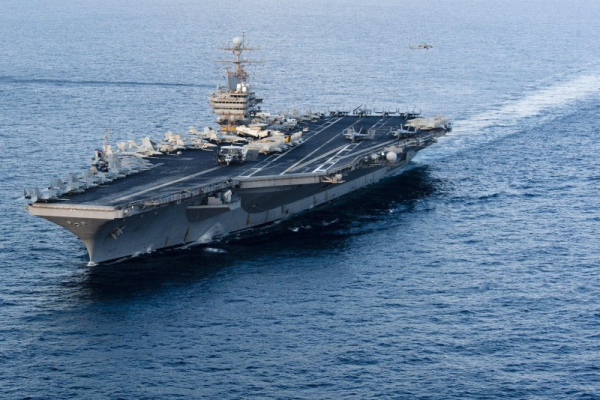
The USS Abraham Lincoln is leading an armada of warships that might intervene in civil unrest in Iran, which has scheduled two days of live-fire naval drills in the Strait of Hormuz that start on Sunday. File Photo by UPI/Will Tyndall/U.S. Navy | License Photo
The Iranian military intends to conduct two days of live-fire naval drills in the Strait of Hormuz, starting on Sunday, despite warnings against it from the U.S. military.
Iran’s Islamic Revolutionary Guard Corps is conducting the drills amid civic unrest and U.S. President Donald Trump deploying a “massive armada” to the area, led by the aircraft carrier USS Abraham Lincoln.
“U.S. forces acknowledge Iran’s right to operate professionally in international airspace and waters. Any unsafe and unprofessional behavior near U.S. forces, regional partners or commercial vessels increases risks of collision, escalation, and destabilization,” CENTCOM officials said in a statement on Saturday.
“CENTCOM will ensure the safety of U.S. personnel, ships, and aircraft operating in the Middle East. We will not tolerate unsafe IRGC actions, including overflight of U.S. military vessels engaged in flight operations, low-altitude or armed overflight of U.S. military assets when intentions are unclear, high-speed boat approaches on a collision course with U.S. military vessels, or weapons trained at U.S. forces,” CENTCOM said.
The Strait of Hormuz connects the Gulf of Oman and the Persian Gulf, with Iran situated along its northern shore and Oman and the United Arab Emirates along its southern shoreline.
More than 100 merchant vessels per day sail through the strait, which makes it an “essential trade corridor” that supports the region’s economy, CENTCOM said, as reported by Fox News.
The deployment comes as the Trump administration considers potential military intervention in the Iranian unrest.
Various estimates place the number of protestors and other civilians killed at between 6,000 and more than 30,000 since protests began on Dec. 28.
Saudi Defense Minister Prince Khalid bin Salman attended a private briefing in Washington, D.C., on Friday and warned that Iran would grow stronger if the United States does not act in Iran is warranted if military action is warranted, Axios reported.
Trump has threatened to target Iran’s leadership with military strikes if widespread killings of protesters continued, but he delayed any strikes after Saudi leaders cautioned against it.
Salman’s comments on Friday indicate a change among Saudi Arabia’s leadership regarding potential military action in Iran.
Meanwhile, Iranian Foreign Minister Abbas Araghchi on Saturday accused the U.S. military of trying to dictate how the Iranian military conducts “target practice on their own turf.”
“Freedom of navigation and safe passage of commercial vessels in the Strait of Hormuz are of vital importance for Iran, as much as it is for our neighbors,” Araghchi added.
“The presence of outside forces in our region has always caused the exact opposite of what is declared: promoting escalation instead of de-escalation,” he said.
The pending military exercise also is scheduled after Iranian state media reported an explosion damaged a nine-story residential building and killed a young girl and injured 14 in Bandar Abbas, which is an Iranian port city located on the Strait of Hormuz.
Iran’s Fars News Agency denied reports that IRGC Navy leader Brigadier Gen. Alireza Tangsiri died in the blast, which local officials said likely was caused by a gas leak.
“The initial cause of the building accident in Bandar Abbas was a gas leak and buildup, leading to an explosion,” Bandar Abbas Fire Chief Mohammad Amin Lyaghat told Iranian state media. He called the explanation an “initial theory.”
This week in Washington
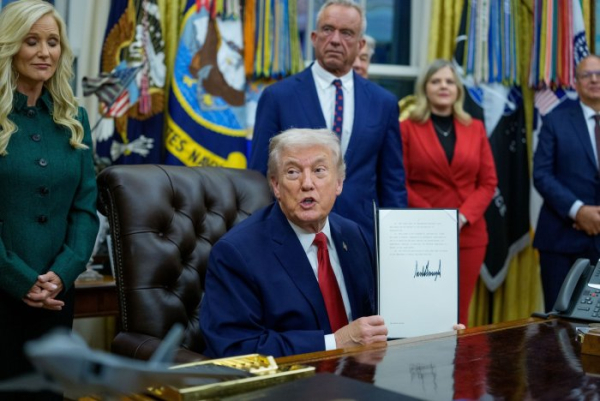
President Donald Trump poses with an executive order he signed during a ceremony inside the Oval Office of the White House on Thursday. Trump signed an executive order to create the “Great American Recovery Initiative” to tackle drug addiction. Photo by Aaron Schwartz/UPI | License Photo
