

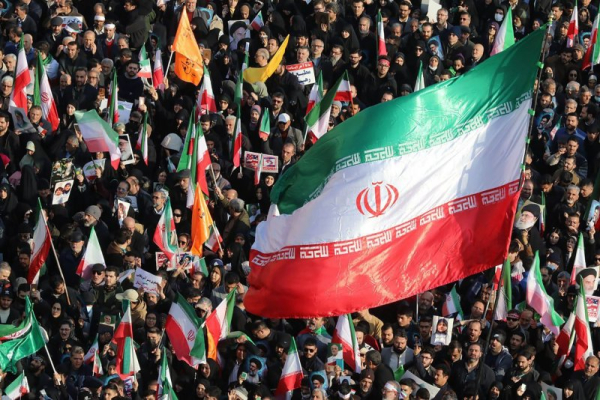
Iranians participated in a pro-government rally in Tehran, Iran, on Monday. The rally was held in Tehran in response to the recent anti-government unrest, expressing opposition to the U.S. and Israel, and showing support for Supreme Leader Ayatollah Ali Khamenei. Photo by Iranian Leader’s Press Office/UPI. | License Photo
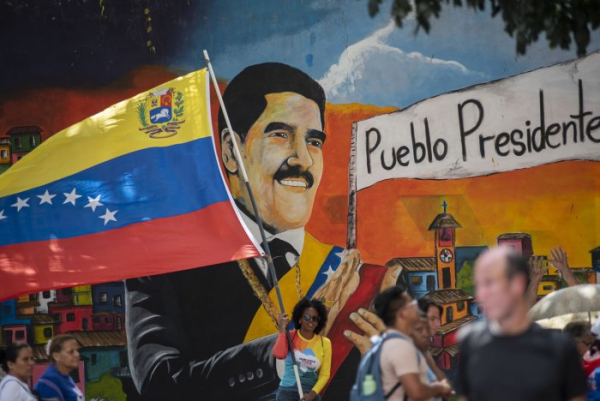
Supporters of ousted Venezuela’s President Nicolas Maduro carry his portrait during a rally outside the National Assembly in Caracas, Venezuela on Monday. Photo by Jonathan Lanza/UPI | License Photo
Iran’s judiciary denied reports that it planned to execute protester Efran Soltani, whose planned execution drew an international outcry.
Human rights organization Hengaw, based in Norway, said earlier this week that Soltani’s family was told he was to be executed on Wednesday. Hengaw said the execution was “postponed” but said there were “serious and ongoing concerns” about his life, the BBC reported.
For 18 days, Iranians have protested the nation’s economic crisis, in which they have faced violent opposition from security forces. The regime has created an Internet blackout for nearly seven days, according to the NetBlocks Internet observatory. Human rights activists worry the blackout is to shield the world from Iran’s crimes.
According to Human Rights Activists News Agency, at least 2,435 protesters, including 13 children and 153 people affiliated with the security forces or government, have been killed since the protests began. It said another 18,470 protesters have been arrested.
President Donald Trump announced Wednesday evening that Iran has called off scheduled executions of detained protesters and that the killings in the street were stopping.
“We’ve been told that the killing in Iran is stopping. It’s stopped. It’s stopping, and there’s no plan for executions or an execution,” he told reporters. He didn’t offer details.
“This is good news. Hopefully, it will continue!” Trump said. He had warned Iran not to execute protesters.
The Islamic Republic of Iran Broadcasting — the country’s state-controlled media — said on social media that Soltani faced “charges of assembly and collusion against national security and propaganda against the system.” But, it said, there is no death penalty in Iran for those charges.
“If the charges are confirmed by the prosecutor’s office and a legal verdict is issued by a competent court, the punishment provided for by law will be imprisonment,” the New York Times reported IRIB said.
IRIB called reports by foreign media that Soltani, 26, faced execution a “blatant act of news fabrication.”
It said Soltani is in the Central Prison of Karaj, which is west of Tehran.
Soltani was arrested at his home last Thursday in Fardis, according to Hengaw and his family.
But the judiciary said he was arrested during “riots” on Saturday.
Iran’s foreign minister Abbas Araghchi said Wednesday that Iran never planned to execute prisoners.
Chief Justice Gholam-Hossein Mohseni-Ejei said Thursday that prosecutions of the “rioters” would happen quickly.
“Those elements who were connected to foreign intelligence services and their handlers, and who provided direction to rioters and terrorists either on the ground or from outside, are among the top priorities for prosecution and punishment,” IRIB quoted Mohseni-Ejei as saying.
On Wednesday, the United States and Britain began pulling non-essential personnel from the Al-Udeid air base in Qatar ahead of potential U.S. military intervention against Iran.
