


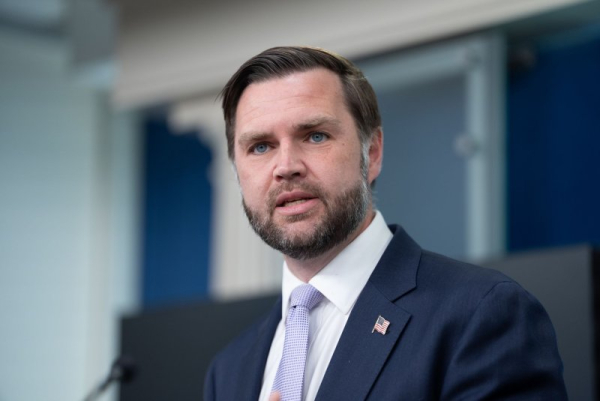
U.S. Vice President JD Vance said Monday that as part of an agreement due to be formally signed this week, International Atomic Energy Agency inspectors would be allowed into Iran to oversee the dismantling of its nuclear program. File Photo by Aaron Schwartz/UPI | License Photo
U.S. Vice President JD Vance said nuclear inspectors would be allowed back into Iran to verify Tehran was in compliance with the terms of a framework agreement to end the three-and-a-half-month war due to be signed Friday in Switzerland.
Vance told NBC News on Monday night that the destruction of Iran’s stockpile of enriched uranium under the supervision of the U.N.’s nuclear watchdog, the International Atomic Energy Agency, formed a key part of the Memorandum of Understanding.
“One of the core parts of the agreement is that the IAEA and the United States are going to help Iran destroy the highly enriched stockpile, and that’s something that’s spelled out very clearly,” Vance said.
He said the timing and exact details of how this would be done would be the subject of technical negotiations on Iran’s nuclear program that would be set in motion with the MOU signing, adding that given the “broad agreement” on the issue, he believed access for the inspectors would happen “very quickly.”
Vance told CNN the deal was transactional, designed to rehabilitate Iran into the global community — a staggered approach where it would receive benefits at each step of the process, with foregoing developing a nuclear bomb and commitment to regional stability and ending support for designated terror groups topping the list.
He stressed that the agreement being signed on Friday was a broad framework — a general document only around a page and a half long.
“On a number of issues, we are going to have to figure this stuff out during the technical negotiation phase, but what the MOU does is set up a framework whereby the Iranians get the benefits of the bargain by meeting their obligations under the bargain,” he added.
“If the Iranians comply, benefits will flow to them, and that’s what we hope to see. We want them to behave like a normal country. We want them to have a successful country but only if they do what’s necessary to commit long-term to not building a nuclear weapon.
“Giving up the enriched uranium is the thing we have focused the most on. They will get benefits for that. Making their country investable, they will get benefits from that. As they perform their end of the bargain, then more and more benefits flow to them. If they do less, then less, potentially nothing, flows to them,” said Vance.
He rejected suggestions the approach was little different from the Joint Comprehensive Plan of Action negotiated under former U.S. President Barack Obama, describing the JCPOA as “bribing” Iran not to develop a nuclear weapon and that Gulf Arab countries “hated” it because it “empowered” Iran to be a bad actor in the region.
Vance insisted international shipping would be able to transit the Strait of Hormuz freely — despite claims by the Iranian Foreign Ministry that Iran will impose navigation fees and other charges to use the critical sea lane, saying it was pre-negotiation spin by Tehran.
He said that the MOU stated that for the duration of the 60 days the parties were negotiating the final deal, access would be toll-free in both directions and that some elements within the regime were clearly trying to talk up what Iran was getting out of it and play down the United States’ gains.
“We have to recognize that this is what happens in an agreement like this… but the truth is that tolls will not be charged, the Strait of Hormuz will be open,” Vance said.
He said the situation should be judged less by statements out of Tehran and more by the “massive increase already in oil that’s coming out” through the strait.
Vance said Iranian references to tolls could be related to potential fees for assisting ships that had broken down or got into other difficulties in the Hormuz Strait, but stressed the United States had made it clear it would not permit a system where vessels were charged for transiting the shipping lane.
This week in Washington
President Donald Trump speaks to reporters about restoring commercial fishing access to areas of the Pacific during a signing ceremony in the Oval Office of the White House on Thursday. Photo by Jim Lo Scalzo/UPI | License Photo
