

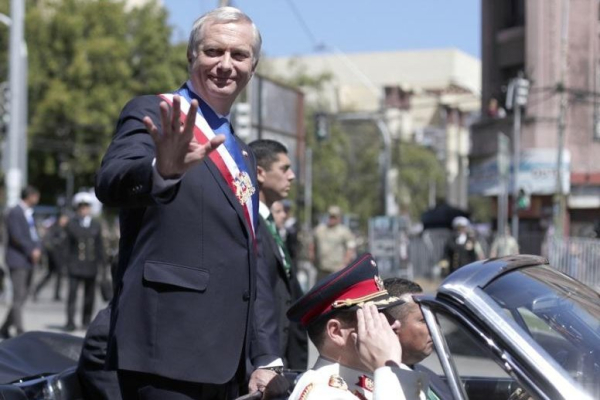
Far-right politician Jose Antonio Kast greets supporters after taking office as [resident of Chile in an inaugural ceremony in Valparaiso on Wednesday. Parliamentarians from all parties and a dozen heads of state and government from around the world attended. Photo by Ailen Diaz/EPA
Conservative leader José Antonio Kast was sworn in Wednesday as president of Chile, taking office from outgoing leftist President Gabriel Boric and vowing a hardline response to crime and irregular migration.
Kast, a 60-year-old lawyer and former leader of the Republican Party, won the presidency on his third attempt, campaigning on what he called an “emergency government” focused on dismantling organized crime networks and tightening border controls.
The inauguration ceremony was held at Chile’s National Congress in the port city of Valparaiso and attended by about 1,100 guests, including some Latin American presidents, Spain’s King Felipe VI, Venezuelan opposition leader María Corina Machado and U.S. Deputy Secretary of State Christopher Landau.
The transfer of power came amid heightened security concerns after a police officer was shot in the head during a routine inspection in southern Chile earlier Wednesday.
“Starting today, things are going to change. Anyone who attacks a Carabinero attacks all of us, and I promise we will pursue them, find them, prosecute them and put them behind bars,” Kast said minutes before formally taking office, referring to Chile’s national police force.
Public concern over crime has grown in recent years, with rising reports of homicides, kidnappings and extortion. While crime rates remain below those of several other South American countries, many Chileans describe the country as increasingly affected by transnational gangs.
Kast has pledged swift action against criminal groups that authorities widely linked to gangs originating in other Latin American countries. He also said he plans to deport about 350,000 migrants living in Chile without legal status and close the country’s northern border.
Kast’s election comes amid a broader conservative shift in parts of Latin America. Last week he attended the “Shield of the Americas” summit in near Miami alongside allies of U.S. President Donald Trump.
Foreign policy tensions marked the final days of Boric’s administration, particularly over a proposed undersea fiber-optic cable connecting Chile and Hong Kong. U.S. officials have expressed concern about the project, reflecting Washington’s broader scrutiny of Chinese involvement in critical infrastructure in the region.
U.S. Ambassador to Chile Brandon Judd, who attended the inauguration, said he expects ties with the Trump administration to improve under Kast.
“I know the relationship will be better because he is always thinking about Chile’s sovereignty. And when we talk about critical infrastructure, Kast will safeguard Chile,” Judd said.
He said the United States does not object to Chile maintaining economic and trade relations with China, but is concerned about projects that involve critical infrastructure.
“We know business is important for all countries. If they do business with China, that is fine. It is critical infrastructure that concerns us,” he said.
On the economic front, the new government plans to cut $6 billion in public spending over 18 months. Finance Minister Jorge Quiroz has ordered a 3% across-the-board reduction in government expenditures for all ministries.
