


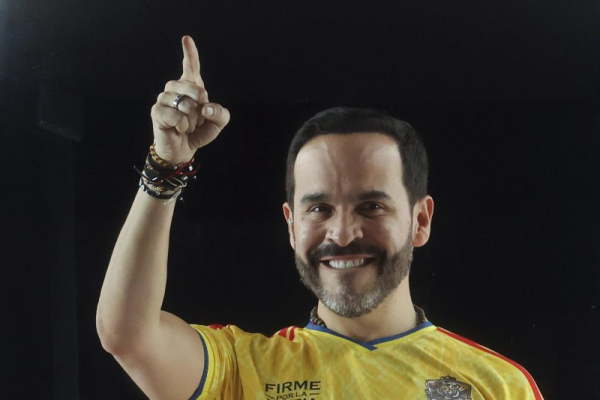
1 of 2 | Far-right candidate Abelardo de la Espriella has defeated leftist Ivan Cepeda for the Colombian presidency. Photo by Mauricio Duenas Castaneda/EPA
Colombia and Peru have elected two of Latin America’s most conservative right-wing leaders after electoral authorities confirmed the victories of Abelardo de la Espriella in Colombia and Keiko Fujimori in Peru.
The two elections, both decided by razor-thin margins, mark a political shift in the Andean region after years of left-wing governments in both countries.
De la Espriella and Fujimori campaigned on platforms centered on strengthening public security, expanding the role of law enforcement in fighting organized crime, supporting free market economic policies and promoting socially conservative positions.
Colombian media reported that the National Electoral Council officially proclaimed De la Espriella president for the 2026-30 term after confirming his victory over government-backed candidate Iván Cepeda by less than one percentage point. The lawyer and businessman won 12.9 million votes, or 49.66% of valid ballots, compared with Cepeda’s 48.70%.
The result ends the presidency of leftist Gustavo Petro and returns Colombia’s government to the political right. During the campaign, De la Espriella pledged to intensify the fight against organized crime, promote pro-business economic reforms and strengthen security and counternarcotics cooperation with the United States.
In Peru, Keiko Fujimori finally won the presidency on her fourth bid after narrowly defeating left-wing candidate Roberto Sánchez in a runoff election. With 99.8% of ballots processed by the National Office of Electoral Processes, analysts confirmed a mathematically irreversible lead of 50.1% to 49.8%, a margin of just 43,386 votes, Spanish newspaper El País reported.
The final stage of the 17-day vote count followed the pattern of close and highly contested elections that has characterized Peru in recent years.
Sánchez, representing the left-wing coalition Juntos por el Perú, held a narrow lead during the early stages of the count, supported by strong results in southern Peru and the Andean highlands. The trend reversed, however, after ballots cast by Peruvians living abroad were counted. Overseas voters provided the margin Fujimori needed to secure victory, leaving the remaining uncounted ballots unable to change the outcome.
The victory returns the Fujimori political movement to Peru’s presidential palace 26 years after the fall of the government led by her father, former President Alberto Fujimori.
The president-elect has pledged to preserve Peru’s free market economic model established under the country’s 1993 Constitution, strengthen security policies to combat organized crime and advance conservative social policies. Unlike several of her predecessors, she is also expected to begin her term with a stronger congressional bloc capable of advancing her legislative agenda.
Peru’s electoral authorities must still resolve challenges involving approximately 0.13% of ballots before officially certifying the results. Television network Canal N reported that the National Jury of Elections expects to formally proclaim the winner between July 3 and July 7.
Both elections exposed deep political divisions.
In Peru, Sánchez alleged electoral fraud and filed legal challenges contesting part of the vote count. In Colombia, Cepeda ultimately accepted the official results but said his coalition would serve as a strong opposition force in Congress.
With Argentina, El Salvador, Ecuador, Chile, Paraguay and now Colombia and Peru governed by right-wing or center-right administrations, the political balance in Latin America has shifted further to the right after several years in which left-leaning governments dominated much of the region.
Despite the political shift, analysts say both De la Espriella and Fujimori will take office with electorates divided almost evenly in half, setting the stage for difficult negotiations and intense political confrontation during the early months of their administrations.
