

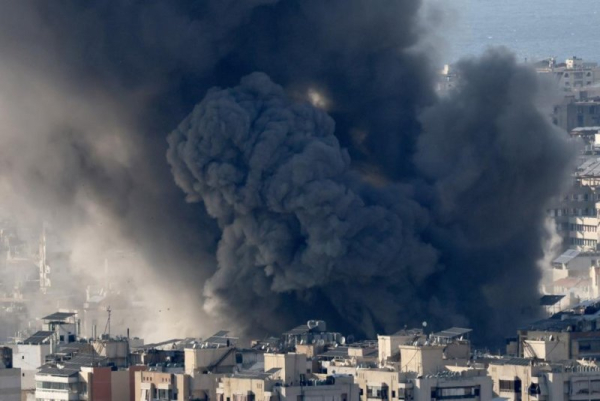
Smoke billows after an Israeli airstrike in Bourj Al Barajneh, in the southern suburbs of Beirut, Lebanon, on Monday. The Israeli military said it is conducting strikes across the country targeting Hezbollah infrastructure and personnel. Photo by Wael Hamzeh/EPA
Lebanon’s government on Monday prohibited Hezbollah from all military activities, hours after the Iran-backed group fired missiles and drones into northern Israel, triggering retaliatory Israeli strikes on Beirut’s southern suburbs and other areas that killed at least 52 people and wounded 154.
Prime Minister Nawaf Salam reiterated after a five-hour Cabinet meeting that the decision of war and peace “rests exclusively in the hands of the Lebanese state,” necessitating the immediate prohibition of all Hezbollah security and military activities as “unlawful.”
Salam, whose government ordered Hezbollah’s disarmament last August, said the group should hand over its remaining weapons to the Lebanese state and limit itself to political activities.
He called on all military and security agencies to take immediate action to enforce the Cabinet’s decision, prevent any military operations or launching missiles or drones from Lebanese territory, and apprehend any violators.
He sharply criticized firing missiles and drones into northern Israel shortly after midnight — a strike that Hezbollah said was “to avenge” the killing of Iran’s Supreme Leader Ayatollah Ali Khamenei and “in self‑defense” against Israel’s continued aggressions on Lebanon.
Salam called on the army to start implementing the next phase of its plan to assert state control and disarm Hezbollah “immediately and firmly,” reiterating that Lebanon should not be dragged into a U.S.‑led war involving Iran.
He called on the United States and France, which brokered the Nov. 27, 2024, cease-fire agreement that ended the Israel-Hezbollah war, to secure “a clear commitment” from Israel to halt its aggression against Lebanon, which is ready to resume truce negotiations.
President Joseph Aoun said during the Cabinet session that what happened does not defend Lebanon or protect the Lebanese people, but would only result in “more misery, destruction and displacement.”
“Did the launching of missiles deter Israel or threaten Lebanon again?” he asked. “It only gave Israel the pretext to destroy the country. … The one who fired the missiles bears the responsibility for his reckless actions, not the Lebanese people.”
All but two of the Cabinet’s 24 ministers adopted the government’s decision, with only the health and labor ministers, who represent Hezbollah, objecting.
According to the Health Ministry, at least 31 people were killed and 149 wounded in Israeli strikes that targeted Beirut’s southern suburbs — Hezbollah’s stronghold – and southern Lebanon. The Israeli attacks triggered a large wave of displacement, forcing thousands of people to leave their homes quickly and seek shelters in Beirut and other safer areas.
The Israeli Army said it has killed Hezbollah intelligence chief, whom it identified as Hussein Mokalled, during an overnight strike in Beirut.
Reports indicate that Mohammad Raad, head of Hezbollah’s parliamentary bloc, also was killed. However, Hezbollah has not confirmed either assassination.
The Israeli Army said that its strikes targeted senior Hezbollah commanders in the Beirut area, while the Air Force and Navy attacked dozens of command centers across Lebanon.
“Hezbollah chose to join the Iranian terror regime and will now bear the consequences of the attack against Israel,” the Army said, according to the Israeli English-language website, Ynet.
Moreover, Israeli Defense Minister Israel Katz threatened Hezbollah Secretary-General Sheikh Naim Qassem, saying he “is a marked target for elimination.”
‘Whoever follows Khamenei’s path will soon find himself alongside him in the depths of hell, together with all the eliminated members of the axis of evil,” Katz said in a statement.
The Israeli army issued evacuation orders to residents of Beirut’s southern suburbs and to dozens of villages in southern and eastern Lebanon, advising them to stay away from Hezbollah positions and buildings housing the group’s financial arm, the U.S.-sanctioned Al-Qard Al-Hassan.
