

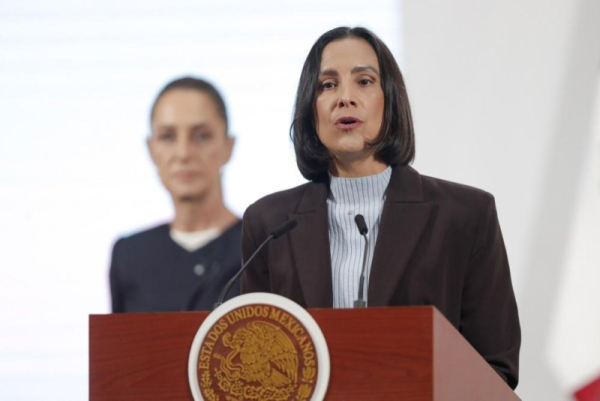
Energy Secretary Luz Elena Gonzalez said the Pemex strategy aims to overhaul internal processes and bolster Mexico’s energy security, with an emphasis on production and financial stability File Photo by Isaac Esquivel/EPA
Petróleos Mexicanos, Mexico’s state-owned oil company known as Pemex, announced Wednesday a $24.7 billion investment program to increase and sustain crude oil production under a plan presented by President Claudia Sheinbaum’s government.
The spending represents a 34% increase from the previous year. Pemex said the plan targets crude output of 1.8 million barrels per day and an expansion in natural gas production to 4.5 billion cubic feet per day through strategic projects by 2030.
The Pemex Strengthening Plan 2025-2035 also includes measures to cut debt and improve the company’s financial stability.
Energy Secretary Luz Elena Gonzalez said the strategy aims to overhaul internal processes at Pemex and bolster Mexico’s energy security, with an emphasis on production and financial stability, according to local outlet Cronica.
Gonzalez said coordination with the Finance Ministry allowed the government to deploy financial instruments in 2025 that reduced Pemex’s total debt by 20%, a result she described as unprecedented for the company.
Pemex said the financial improvements strengthened its credibility to attract new investments planned for 2026, while stabilizing crude production in 2025 and ensuring sufficient supply for the country’s refining system.
Officials said higher output offset the natural decline of large oil fields, resulting in a net increase of more than 122,000 barrels per day.
Pemex CEO Victor Rodriguez Padilla said the company maintained a positive refining margin averaging $12 per barrel and argued that refining “is a profitable business for the benefit of the Mexican people.”
He said Pemex will continue to prioritize investments to strengthen its production platform and domestic processing.
Speaking at a public briefing, Rodriguez Padilla said Pemex’s debt fell to its lowest level in 11 years after a $20 billion reduction in 2025 compared with 2018, according to digital outlet El Financiero.
“That trend has been reversed,” he said, referring to the sharp debt buildup in earlier years.
Gonzalez also said credit rating agencies upgraded their assessment of Pemex, a move she said would support productive investment and reinforce the government’s energy sovereignty strategy.
During the same briefing, President Sheinbaum said Pemex “has recovered as a public company” and stressed the importance of processing oil domestically to reduce fuel imports.
She said the effort includes coordination with the Finance Ministry to renegotiate debt maturities.
The 2025-2035 plan is not limited to balance sheet repairs and has a direct impact on the broader economy, according to Vanguardia MX.
According to the Mexican authorities’ plan, Pemex will regain the confidence needed to carry out large-scale operational initiatives by cleaning up its finances.
This shift in financial direction underpins President Claudia Sheinbaum’s ambitious public investment program aimed at transforming the hydrocarbons industry in the coming years.
