


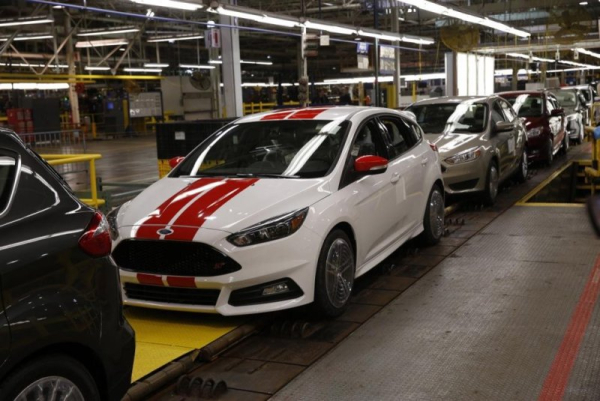
Led by Mexican Economy Secretary Marcelo Ebrard, a multidisciplinary team aims to strengthen Mexico’s position on key issues, including automotive rules of origin and steel tariffs. File Photo by Jeff Kowalsky/EPA
Mexico’s government has assembled a high-level economic team with a strong technical focus ahead of strategic negotiations with the United States over the review of the United States-Mexico-Canada Agreement, known as USMCA, scheduled for May.
Led by Economy Secretary Marcelo Ebrard, the multidisciplinary team aims to strengthen Mexico’s position on key issues, including automotive rules of origin and steel tariffs.
The move reflects Mexico’s effort to bring together specialists with experience in the USMCA across sectors such as agribusiness, advanced manufacturing, financial services, telecommunications and diplomacy as part of a unified trade defense strategy.
Mexican President Claudia Sheinbaum confirmed Thursday that she has nominated economist Roberto Lazzeri Montaño as Mexico’s next ambassador to the United States at a critical moment in bilateral relations.
According to Mexican media reports, the administration prioritized a technical profile for the diplomatic post in Washington to reinforce the negotiating delegation with a more strategic rather than political approach.
“He has a good relationship with the Mexican government and with his counterparts in the United States because that was one of his responsibilities,” Sheinbaum said.
The restructuring of Mexico’s economic team follows a visit this week to Mexico City by U.S. Trade Representative Jamieson Greer, during which both sides agreed to begin an intensive negotiation phase May 26.
Ahead of the final trilateral review scheduled July 1, the new negotiating team has been tasked with preserving certainty in regional supply chains and securing a 16-year extension of the trade agreement.
“We are interested in maintaining the trade agreement among the three countries,” Sheinbaum said Friday during her morning press conference.
After a meeting of Mexico’s economic cabinet, Ebrard said the main challenge in renegotiating the USMCA with the United States is the gap between Washington’s current trade approach and the free-trade principles on which the agreement was originally based, according to Infobae.
Ebrard said Mexico is prepared to begin talks focused on reducing the dependence both countries have on imports from Asia in sectors including semiconductors, pharmaceuticals and electronics, where imports currently exceed 85%.
Mexico and the United States are seeking to expand production of those goods in North America. Discussions are expected to focus on how manufacturing responsibilities will be divided and how tariff-free regional supply chains will operate.
Ebrard said the renegotiation would face challenges because the U.S. government continues to favor a trade strategy centered on tariffs and stricter rules of origin, according to the newspaper Expansión.
“The main problem is that there are two different ideas,” Ebrard said of the negotiations.
He added that the original agreement was based on trade liberalization, while the current U.S. approach prioritizes control and regional content requirements.
“The trade system we had, based on free trade, is very unlikely to return. We should not be nostalgic for the days when there were no tariffs. Now we are going to be in a system where there are tariffs and also rules of origin. It will not be easy. It will be difficult and complex. There are many uncertainties, but we are going to make a major effort,” Ebrard said.
The Economy Secretary added that Mexico remains competitive in terms of effective tariffs compared with Asian countries, with an average tariff rate of 4% compared with 30% for China and 20% for Vietnam, a factor he said has supported continued growth in Mexican exports.
