

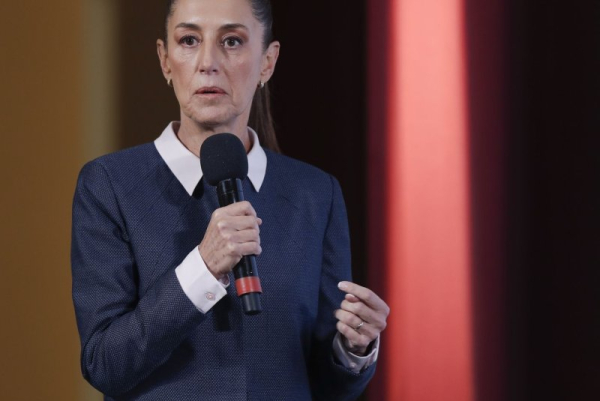
Insisting that her reforms are to strengthen democracy and not a shift toward authoritarianism, Mexican President Claudia Sheinbaum announced Tuesday that she will pursue electoral reform included in her administration’s “100 commitments” policy agenda. File Photo (2024) by Isaac Esquivel/EPA-EFE
Mexican President Claudia Sheinbaum announced Tuesday that she will pursue electoral reform included in her administration’s “100 commitments” policy agenda.
Speaking at her morning press conference on June 24 at the National Palace, Sheinbaum said the proposal aims to reduce government spending and strengthen democratic institutions.
“Many resources are allocated for elections,” she said, adding that clean, democratic votes can be ensured with less spending.
Sheinbaum outlined several key elements of the proposed reform.
The plan would reduce the operating budget of the National Electoral Institute (INE) and lower the cost of organizing elections, which recently amounted to about 8 billion pesos ($423 million in U.S. dollars)
The plan also calls for cutting public financing for political parties.
Another provision would eliminate proportional representation seats in both chambers of Congress, reducing the overall number of lawmakers and prioritizing direct elections.
“It’s very important to eliminate the proportional seats,” Sheinbaum said, adding that the change would strengthen local representation and the role of the popular vote.
The reform also would restructure the INE into a single national body responsible for administering both federal and local elections. It would reduce the number of electoral councilors from 11 to 7, all elected by popular vote. However, Sheinbaum said the INE “remains an autonomous body and must remain so,” dismissing any intention to strip it of its independence.
Following the controversial June 1 popular election of judges and magistrates, five INE councilors reported serious irregularities before certifying the results. Sheinbaum accused the councilors of overstepping their authority and taking a political stance against her administration. She also said the INE encroached on the powers of the Electoral Tribunal by attempting to discard votes — an act she called “undemocratic.”
Sheinbaum said the government will launch a working group in September to draft a detailed version of the reform and present it to Congress.
Ricardo Monreal, leader of the ruling Morena party in the Chamber of Deputies, confirmed his bloc’s support and said debate will begin in the next regular legislative session, starting Sept. 1.
As a constitutional amendment, the proposal would require a two-thirds majority in both houses of Congress and ratification by at least 17 of the country’s 32 state legislatures to take effect.
Following the 2024 elections, Morena and its allies — the Green Party and the Labor Party — hold a comfortable majority in both chambers of Congress, enough to approve constitutional reforms without support from the opposition.
The proposed electoral reform revives key elements of a 2022 initiative introduced by former President Andrés Manuel López Obrador, which failed at the time due to the lack of a qualified majority.
Ruling party lawmakers say the new proposal is a necessary update to Mexico’s electoral framework. They argue that both party financing and the structure of the electoral authority should be revised to reflect the country’s “new realities.”
“There must be a comprehensive reform that includes replacing councilors, if necessary. It’s not about creating an INE tailored to anyone’s interests, but one adapted to new realities,” Sen. Saúl Monreal of the ruling Morena party told El Universal.
Opposition parties have strongly rejected the proposal, warning that it seeks to concentrate power and weaken democratic checks and balances.
PAN lawmaker Ricardo Anaya accused the government of trying to establish “an authoritarian regime” and take full control of the electoral process. “They want an INE tailored to their interests so they can steal elections when they lose public support,” Anaya said.
Leaders of the PRI echoed the criticism. Sen. Manuel Añorve called the proposal a targeted effort to remove the five INE councilors who questioned the judicial election and replace them with figures aligned with the government.
Sen. Carolina Viggiano, also of the PRI, denounced what she described as “systematic attacks” by the ruling party against the INE and warned that Morena seeks to consolidate a one-party system by subordinating autonomous institutions.
President Sheinbaum has insisted the reform is intended to strengthen democracy and does not mark a shift toward authoritarianism.
“It is false, false, false that we are an authoritarian government,” she said, rejecting opposition claims.
She also clarified that the proposed changes would not apply to the 2027 federal elections.
