

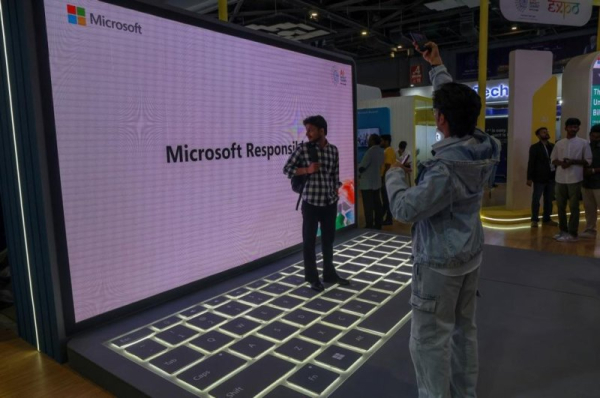
Visitors explore the Microsoft pavilion at the AI Impact Summit 2026 at Bharat Mandapam in New Delhi, India, where Microsoft on Wednesday announced a $50 billion investment to narrow the global AI divide. Photo by Rajat Gupta/EPA
Microsoft announced Wednesday it’s allocating $50 billion over the next 10 years to combat artificial inequality in low-income nations during an event in India.
The Redmond, Wash.-based company said it intends to bridge the AI divide among nations and ensure equal access to its many potential benefits. Company officials revealed the plan at the AI Impact Summit in New Delhi, India.
The summit has made AI inequality among nations a focal point for its attendees, and Microsoft officials said a relative lack of access to electricity in the Global South when compared to the Global North has hindered the development of and access to AI in the world’s less-developed countries.
“Unless we act with urgency, a growing AI divide will perpetuate this disparity in the century ahead,” Microsoft President Brad Smith and Chief Responsible AI Officer Natasha Crampton said in a joint release.
“Solutions will not come easily,” they added. “The needs are multifaceted and will require substantial investments and hard work by governments, the private sector and nonprofit organizations.”
Microsoft researchers show that the Global North, which generally is made up of the developed nations located in the Northern Hemisphere, had nearly double the amount of AI diffusion — 24.7% — than those located in the Global South — 14.1% — at the end of 2025.
The global AI diffusion rate was 16.3% at the end of the year, and the divide between the Global North and Global South is getting wider.
Microsoft is planning a five-part program to narrow the divide and make AI more accessible in the world’s poorer nations, starting with building the kind of infrastructure that is needed to support AI, including data centers.
The tech firm also wants to empower people by supporting technology and skills development for schools and nonprofits and by making AI more multilingual and multicultural.
Microsoft’s effort also would support local AI innovations that address community needs and continually monitor AI diffusion to help guide the development of AI policies and investments.
“Success will require many deep partnerships,” Smith and Crampton said. “These must span borders and bring people and organizations together across the public, private and nonprofit sectors.”
Digital sovereignty needs, cybersecurity, privacy and protecting intellectual property are among AI aspects that they said are important for ensuring successful AI diffusion that narrows the global AI divide.
