

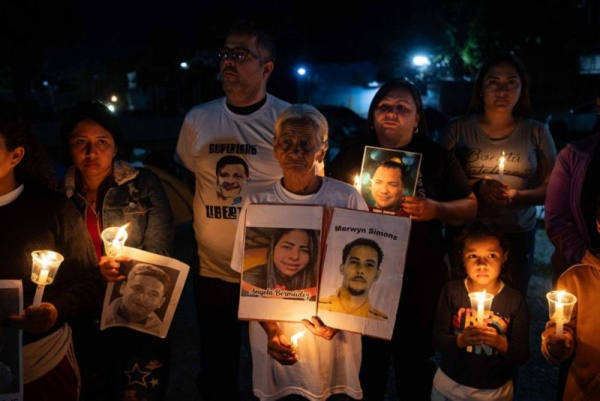
Families participate in a vigil outside the Rodeo I prison in Zamora, Miranda state, Venezuela, in late January, demanding the release of relatives who are political prisoners. Photo by Ronald Pena/EPA
Nearly 300 political prisoners held at El Rodeo I prison on the outskirts of Caracas have launched a hunger strike in demanding their release, relatives said. Families of the detainees reported the protest after authorities excluded them from a recently enacted amnesty law in Venezuela.
“We have had communications with human rights officials at the U.S. Embassy. They are aware that the Venezuelan regime continues mocking victims,” activist Andreína Baduel said Monday during a news conference organized by the Committee for the Freedom of Political Prisoners.
Baduel said 213 people, including Venezuelan nationals and foreigners, are on hunger strike, while 81 others have begun a combined hunger and thirst strike, according to digital outlet Efecto Cocuyo.
Foreign detainees participating in the protest include 21 Colombian nationals and Argentine gendarme Nahuel Gallo, who has complained about limited access to medical care and consular assistance.
Venezuela’s National Assembly on Thursday approved an amnesty law promoted by the interim government led by Delcy Rodríguez. The measure aims to release those prosecuted or convicted for offenses linked to political unrest dating to 1999.
Observers say the amnesty can be interpreted as an attempt by the Venezuelan government to project institutional stability and openness to political dialogue amid U.S. pressure after the capture of former President Nicolás Maduro by the United States.
The law covers the period between 1999 and 2026, but specifies 13 political episodes beginning in 2002. That limitation excludes arrests that occurred during at least 15 of the past 27 years.
It also explicitly excludes people accused of promoting or facilitating armed actions against Venezuelan sovereignty involving foreign actors, as well as security force members convicted of terrorism-related offenses.
Those charges are among the most common at El Rodeo I, where rights group Foro Penal estimates about 120 detainees face military-linked cases, Infobae reported.
Foro Penal said Friday that at least 400 political prisoners could remain outside the scope of the law. The organization also counts more than 600 people still imprisoned for political reasons.
The government denies the existence of political prisoners in Venezuela and maintains that detainees were jailed for criminal offenses.
Families and advocacy groups said the hunger strike also reflects lack of timely medical care at the prison, which they describe as having inhumane conditions. They are urging authorities to carry out the releases announced under the amnesty, newspaper El Comercio reported.
Former opposition lawmaker Juan Pablo Guanipa, freed this week after the amnesty approval, warned that most inmates at El Rodeo I are in fragile health. He shared the message on X and cautioned about risks faced by those participating in the hunger strike.
