


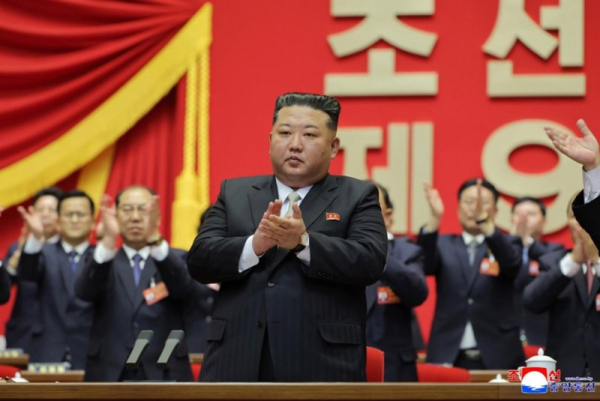
North Korea ramped up executions during the COVID-19 pandemic and intensified crackdowns on South Korean media access, a report released Tuesday said. In this photo, North Korean leader Kim Jong Un appears at a ruling party congress in February. File Photo by KCNA/EPA
North Korea ramped up executions during the COVID-19 pandemic, a report released Tuesday said, as authorities intensified crackdowns on offenses tied to South Korean media and other “anti-reactionary” activity.
The report by the Seoul-based Transitional Justice Working Group examined capital punishment under leader Kim Jong Un’s 13 years in power, documenting at least 153 people executed or sentenced to death between 2020 and 2024 — a 247% increase from the previous five-year period.
The findings draw on testimony from North Korean defectors and reporting from sources inside the country, and form part of TJWG’s long-running effort to map execution practices across the isolated state.
Researchers analyzed 144 documented cases of executions and death sentencings spanning 2011 to 2024, involving at least 358 individuals, and identified 46 execution sites nationwide, including several clustered near central government facilities in Pyongyang.
Executions expanded geographically in the years following the country’s pandemic-era border closure, spreading from a handful of northern areas to cities and provinces nationwide, the report said.
Authorities also shifted the focus of capital punishment away from violent crime toward ideological control, the group said. While executions for homicide fell by 44%, cases tied to South Korean popular culture, religion and so-called “superstitious” practices rose by 250% after 2020.
North Korea sealed its borders at the outset of the pandemic and imposed sweeping controls on information flows. A 2020 law targeting “anti-reactionary thought” allows up to 15 years of forced labor for possessing foreign media and the death penalty for large-scale distribution of South Korean dramas, films or music.
The report found that nearly three-quarters of executions were carried out publicly, often in open spaces such as airfields, riverbanks and marketplaces, reinforcing their role as a tool of intimidation.
The highest number of executions occurred in the early years of Kim’s rule, with more than 80 people killed in 2013. Capital punishment declined after a 2014 U.N. Commission of Inquiry report found the country’s human rights abuses to be “without parallel in the contemporary world” and recommended referring North Korean leaders to the International Criminal Court.
A follow-up U.N. human rights assessment released in 2025 found that North Korea’s human rights situation “has not improved over the past decade and, in many instances, has degraded,” citing worsening food shortages, forced labor and tight restrictions on movement and expression.
Executions rose again after the pandemic border closure, which researchers said coincided with reduced outside pressure and tighter internal controls.
The group warned the trend could worsen as the regime prepares for a potential fourth-generation succession, saying there is a “high risk of increased executions to strengthen cultural and ideological control and maintain political dominance”
“To deter and punish this crime against humanity, the international community should consider the creation of a new accountability mechanism,” Ethan Hee-seok Shin, a legal analyst with the organization, said in a statement. Shin cited U.N. accountability bodies and fact-finding missions in countries such as Syria, Myanmar, Afghanistan and Iran as examples.
The group said it plans to expand its research to North Korean troops deployed to Russia and overseas workers, pointing to what it called the regime’s “threats to international peace” and its “transnational repression.”
