

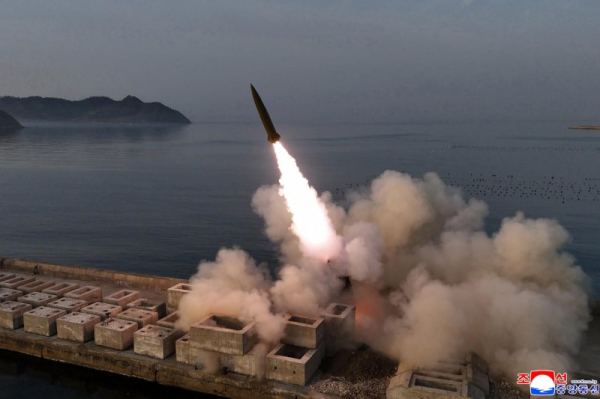
North Korea tested cluster bomb and fragmentation mine warheads on tactical ballistic missiles, state-run media reported Monday. Photo by KCNA/EPA
North Korean leader Kim Jong Un oversaw a test-launch of tactical ballistic missiles carrying cluster bomb and fragmentation mine warheads, state media reported Monday, marking Pyongyang’s second such test this month.
The North’s Missile Administration conducted the launch Sunday using Hwasong-11 Ra short-range ballistic missiles, the official Korean Central News Agency said.
Five missiles were fired toward a target area around an island about 85 miles away, striking a zone of roughly 31 to 32 acres with “very high density,” KCNA reported.
The Hwasong-11, also known as the KN-23, is a highly maneuverable short-range ballistic missile modeled on Russia’s Iskander system and designed to evade missile defenses.
The test aimed to “verify the characteristics and power of cluster bomb warhead and fragmentation mine warhead applied to the tactical ballistic missile,” the report said.
South Korea’s Joint Chiefs of Staff said it detected the launch early Sunday from the Sinpho area on the North’s east coast.
The military would not confirm details of the North’s report on Monday but said South Korean and U.S. intelligence authorities are analyzing the launch.
“Our military is closely monitoring North Korea’s military activities under a strong combined defense posture and maintains the capability to respond overwhelmingly to any provocation,” JCS spokesperson Jang Do-young said at a briefing.
Kim expressed “great satisfaction” with the results, saying the development of multiple warhead types would better meet the operational needs of the Korean People’s Army.
“It is of weighty significance in military actions to boost the high-density striking capability to quell a specific target area,” Kim said, according to KCNA.
Photos released by state media showed Kim attending the test with his daughter, Ju Ae, who has increasingly appeared alongside him at major military events. South Korea’s spy agency said earlier this month that Ju Ae, believed to have been born in 2013, appears to be next in line to succeed her father.
The launch follows a series of recent weapons tests by Pyongyang, including earlier April firings of missiles carrying cluster munitions as well as tests of electromagnetic systems and so-called blackout bombs designed to disable electrical grids.
The tests suggest a growing emphasis on battlefield and asymmetric strike capabilities alongside the North’s nuclear arsenal.
Analysts say the use of cluster warheads could enhance the missiles’ effectiveness against dispersed targets while complicating interception.
“North Korea may deploy cluster munition warheads on its ballistic missiles to make them more difficult to intercept,” the Institute for the Study of War said in a recent update. “This may indicate that North Korea is learning lessons from Iran’s war with the United States and Israel.”
Cluster munitions have drawn renewed scrutiny following their use in recent conflicts, including by Iran. The weapons disperse multiple submunitions over a wide area, and many fail to detonate on impact, posing long-term risks to civilians.
In a March report, Human Rights Watch said Iran’s use of cluster munitions violates the laws of war and may amount to war crimes.
More than 120 countries have joined a convention banning cluster munitions, though North Korea and Iran are not parties. The United States and Israel have also not signed the treaty.
